
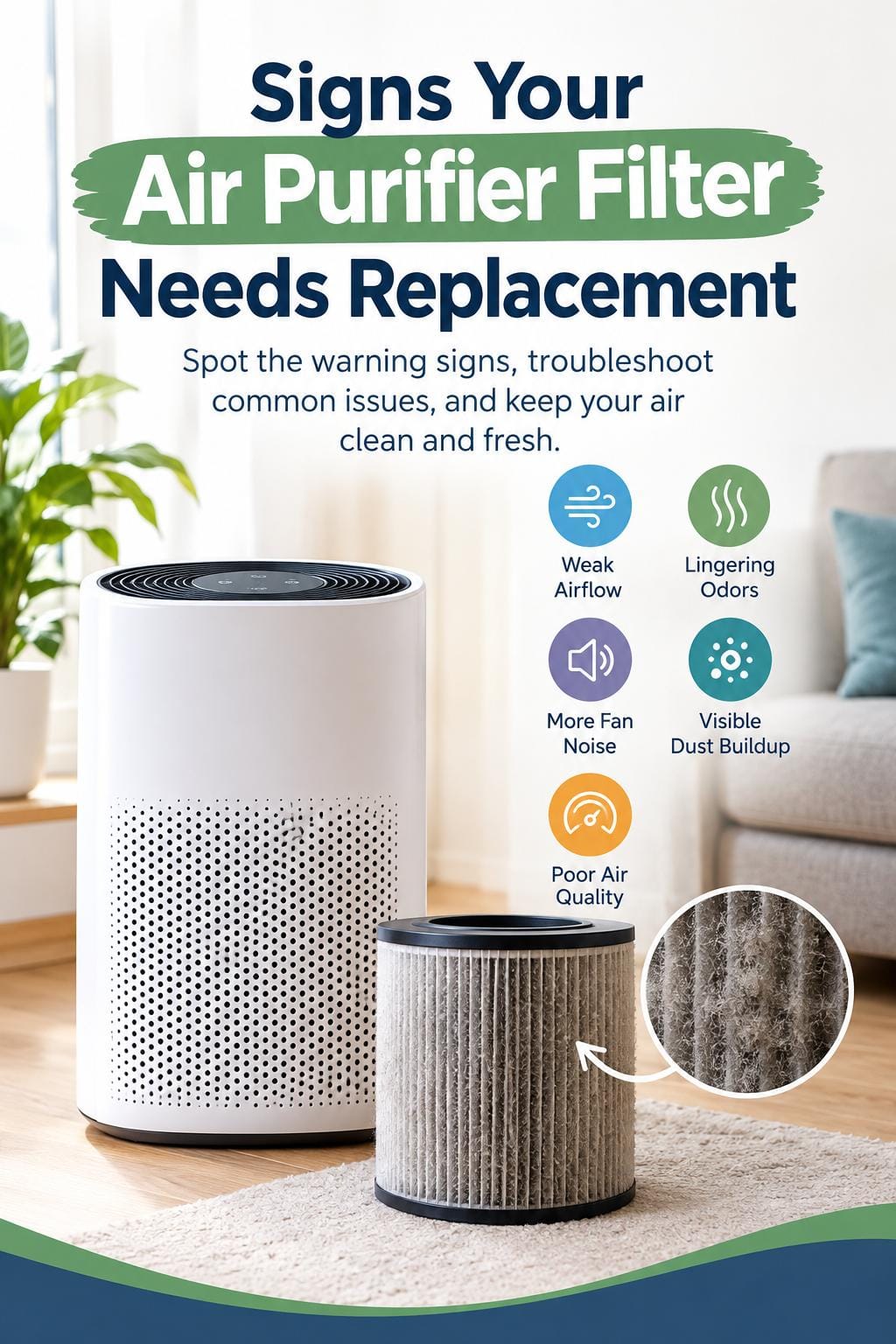
An air purifier can only clean the air effectively when its filter is in good condition. As the filter traps dust, pollen, pet dander, smoke particles, and other pollutants, it gradually becomes loaded. Eventually, airflow can suffer and the purifier may no longer perform as well as it did when the filter was new.
The challenge is knowing when replacement is actually necessary. Waiting for a purifier to stop working is far too late, while replacing a filter too early can waste money. The good news is that most air purifiers provide several clues before the filter reaches the end of its useful life.
Some signs are easy to spot, such as weaker airflow or a visibly dirty filter. Others are less obvious, including longer-lasting odors, unusually high fan speeds, or air-quality readings that never seem to improve.
Here are the key signs to watch for, along with practical checks that can help you determine whether the problem is the filter or something else.
1. Your Air Purifier Has Weak Airflow
One of the clearest signs of a clogged air purifier filter is reduced airflow.
When a filter is fresh, air can pass through the filtration material with relatively little resistance. As dust and fine particles build up, that passage becomes more restricted. The fan may continue spinning normally, but the amount of air moving through the purifier can drop.
You may notice that the stream of air from the outlet feels much weaker than it used to, even when the purifier is running at a higher setting.
Before replacing the filter, check the intake and outlet. Furniture, curtains, bedding, and accumulated dust can block airflow and create symptoms that look like a filter problem. Clearing those obstructions restores the intended airflow path. If the purifier remains weak afterward, inspect the filter.
2. The Filter Is Visibly Loaded With Dust
A visual inspection can tell you a lot, particularly when the filter has been in use for a long time.
Turn the purifier off, unplug it, and remove the filter according to the manufacturer’s instructions. A filter with a thin layer of dust may still be fine, but one that is heavily coated, packed with debris, or noticeably discolored deserves closer attention.
Pet hair and larger particles may collect on the outer surface, while finer dust can become embedded deeper in the filter material. In either case, heavy buildup means the filter has already been doing a significant amount of work.
Avoid shaking a dirty filter indoors. That can release trapped particles back into the room and defeat the purpose of the filtration system.
3. The Room Still Gets Dusty Despite Running the Purifier
If you run an air purifier regularly but continue seeing a surprising amount of dust settling on furniture, the filter is worth checking.
A purifier does not remove every particle from a room instantly. Dust can continue entering through open doors and windows, HVAC systems, clothing, carpets, bedding, and normal household activity. Still, a clogged filter can reduce the volume of air the purifier processes, making it harder to keep airborne particles under control.
Pay particular attention if the change is recent. If the room seemed cleaner for months and suddenly begins collecting more dust, compare the purifier’s airflow and filter condition with its earlier performance.
Also check whether the pre-filter needs cleaning. Removing accumulated hair and larger debris from a cleanable pre-filter can restore airflow without requiring replacement of the main filter.
4. Your Air Purifier Stops Controlling Odors as Well
A purifier that once reduced household smells effectively but now struggles with them may have a saturated carbon filter.
Activated carbon is commonly used to adsorb many odors and certain gaseous pollutants. Its capacity is not unlimited. Once the carbon becomes loaded, odor reduction can decline even if the filter does not look dramatically dirty.
This is often easier to notice in homes with pets or frequent cooking. Kitchen odors may linger longer, or pet-related smells may seem to return more quickly after cleaning.
If odor control was a major reason for buying the purifier, declining performance is a useful signal to inspect the filter’s carbon component and replacement schedule.
5. The Purifier Develops an Unpleasant Smell
There is an important difference between an air purifier failing to remove an odor and the purifier itself producing one.
A musty or stale smell can sometimes be associated with a dirty filter or moisture that has affected the filtration system. Filters can collect organic particles, and under certain conditions that buildup may contribute to unpleasant odors.
Before changing the filter, inspect the unit for obvious moisture or contamination and make sure it is being maintained according to the manufacturer’s instructions.
A burning, electrical, or overheating smell is different. Stop using the purifier and unplug it rather than assuming the filter is responsible. Unusual electrical odors can indicate a problem with the appliance itself.
6. The Filter Replacement Indicator Is On
Many modern air purifiers include a filter-life indicator. When that warning appears, it should not be ignored.
The indicator may be based on elapsed operating time, sensor data, estimated filter life, or a combination of factors. It is designed to remind you that maintenance is due before filtration performance declines too far.
That said, the indicator is not necessarily a perfect measurement of the filter’s physical condition. A purifier operating around pets, dust, or smoke can experience heavier filter loading than a unit used in a relatively clean environment.
Use the warning light as an important maintenance signal, then consider the filter’s age, appearance, and actual performance as well.
7. The Fan Runs Faster or Sounds Louder Than Before
A noticeable change in fan behavior can reveal a developing filter problem.
When airflow through the filter becomes restricted, the purifier may respond by increasing fan speed. On automatic settings, this can result in the machine spending more time at medium or high speed than it normally would.
You may also notice more airflow noise or a higher-pitched fan sound.
This does not automatically mean the filter is clogged. A dirty sensor, blocked intake, or mechanical issue can produce similar symptoms. Start by cleaning accessible exterior areas and checking for obstructions. If the noise and high-speed operation persist, inspect the filter.
8. The Air Quality Reading Doesn’t Improve
Smart air purifiers often display indoor air-quality measurements through a screen, light, or smartphone app.
If the purifier repeatedly reports elevated particulate levels even after running for a reasonable amount of time, investigate the cause rather than immediately assuming the filter has failed.
Cooking, cleaning, candles, open windows, and outdoor pollution can all increase particle levels. Sensor contamination can also affect readings. Many models have a small sensor area that needs occasional cleaning according to the manufacturer’s instructions.
Once obvious sources and sensor issues have been ruled out, check the filter. If it is heavily loaded or well beyond its recommended service life, replacement becomes more likely to help.
9. The Pre-Filter Gets Dirty Very Quickly
A rapidly accumulating layer of hair and dust on the pre-filter can indicate that the purifier is working in a demanding environment.
This is especially common in homes with pets, carpets, and fabrics that shed particles. A pre-filter exists to capture larger debris before it reaches the primary filtration stages.
A dirty pre-filter does not automatically mean the HEPA or main filter needs replacing. Cleaning a washable pre-filter as directed can improve airflow and reduce the burden on the rest of the filtration system.
However, if the pre-filter is clean and airflow remains poor, the main filter deserves inspection.
10. Cleaning the Washable Components Doesn’t Solve the Problem
Regular maintenance can restore performance when the issue is simply dust on a removable pre-filter or exterior vent.
But cleaning the parts that are designed to be cleaned does not make a disposable filter new again.
This distinction matters because some users try to wash or aggressively vacuum filters that were never designed for that treatment. Water can damage certain filter materials, while excessive handling can compromise their structure.
If the manufacturer’s instructions identify the primary filter as replaceable, follow that guidance instead of trying to extend its life through improvised cleaning methods.
11. The Filter Has Reached Its Recommended Service Life
You do not need to wait for dramatic symptoms before replacing a filter.
Every purifier has a recommended maintenance or replacement interval, although the exact duration varies by model and filter type. The published interval provides a practical baseline for routine maintenance.
Consider it alongside your actual usage. A purifier that runs all day, every day, in a busy living space may accumulate contaminants faster than one operating a few hours in a relatively clean bedroom.
The manufacturer’s schedule is therefore a starting point, not a universal rule for every household.
12. The Purifier Has Been Exposed to Heavy Smoke or Dust
Unusual pollution events can shorten filter life considerably.
For example, heavy smoke entering the home, renovation dust, nearby construction, or prolonged exposure to unusually polluted outdoor air can put much more material through the purifier than normal.
After a major exposure event, inspect the filter rather than automatically waiting for the usual replacement date. A filter that has experienced an unusually heavy load may no longer be suitable for extended use.
This is particularly important when odor reduction is involved because carbon filtration can become saturated even when the filter’s exterior does not look dramatically different.
How Often Should You Replace an Air Purifier Filter?
There is no single replacement schedule that applies to every air purifier.
Filter life depends on the purifier’s design, how often it runs, the size of the room, the amount of airborne dust, the presence of pets, smoke exposure, and the type of filtration used.
The safest approach is to follow the manufacturer’s recommended interval while also paying attention to real-world performance. If your purifier runs continuously in a dusty home, checking the filter more often makes sense. If it operates only occasionally in a relatively clean room, it may last longer.
Think of the published interval as a maintenance guide rather than a guarantee.
Can You Vacuum or Wash an Air Purifier Filter?
This depends entirely on the filter type.
Washable pre-filters are often intended to be cleaned regularly because their job is to capture larger particles such as hair and lint. Disposable HEPA and activated carbon filters, however, generally should not be washed unless the manufacturer explicitly says they are washable.
The reason is simple: different filter materials are engineered for different maintenance methods. Washing or aggressively vacuuming the wrong filter can damage the media and reduce its intended performance.
Always check the manual before cleaning a filter.
What Happens If You Keep Using an Old Air Purifier Filter?
An overdue filter does not necessarily cause an immediate breakdown, but performance can gradually deteriorate.
Restricted airflow can make the purifier process less air, while saturated carbon can reduce odor control. In response, the fan may run harder or more often, increasing noise and potentially changing how much energy the appliance uses.
More importantly, the purifier may no longer deliver the level of filtration you expect from it.
Replacing an exhausted filter is therefore part of normal appliance maintenance, much like replacing a vacuum cleaner bag, cleaning an HVAC filter, or servicing another system that depends on airflow.
How to Troubleshoot an Air Purifier Before Buying a New Filter
Before spending money on a replacement filter, rule out simple causes.
Check the Air Intake and Outlet
Make sure there is enough clearance around the purifier. Blocked vents can create weak airflow even when the filter itself is fine.
Inspect the Pre-Filter
If the pre-filter is washable or otherwise designed for cleaning, maintain it according to the instructions. Removing a thick layer of hair and dust can significantly improve airflow.
Clean the Air Quality Sensor
On models with particle sensors, dust on the sensor can affect automatic fan control and reported air quality. Follow the manufacturer’s cleaning instructions to avoid damaging the sensor.
Confirm the Filter Is Installed Correctly
A replacement filter that is not seated properly can allow air to bypass the intended filtration path or restrict airflow unexpectedly. Removing and reinstalling it correctly can solve an apparent performance problem.
Check for an Active Pollution Source
Cooking, smoke, aerosols, candles, cleaning products, and open windows can all increase airborne pollutants. If air-quality readings rise during these activities, the filter may not be the main problem.
Consider the Age of the Filter
If the filter is old, visibly loaded, and showing several performance-related symptoms at once, replacement is usually more sensible than continuing to troubleshoot the purifier itself.
When Should You Replace the Air Purifier Instead of the Filter?
A new filter is usually the first thing to consider when the purifier is otherwise functioning normally. However, there are situations where replacing the entire appliance may make more sense.
An older purifier with recurring fan problems, unreliable sensors, damaged controls, or poor airflow even after a correct filter replacement may have a mechanical or electronic issue. At that point, the cost of repeated repairs and proprietary filters can make a newer model more practical.
A replacement purifier can also be worth considering if your current unit is too small for the room or lacks features that have become important to you, such as automatic fan control, quieter operation, better energy efficiency, or improved filter availability.
The goal is not simply to buy the newest model. It is to determine whether a filter replacement solves the actual problem or whether the appliance itself has reached the end of its useful life.
Final Thoughts
Recognizing the signs of an air purifier filter that needs replacement can save you from both poor filtration and unnecessary spending.
Start with the obvious clues: weaker airflow, a heavily loaded filter, declining odor control, louder fan operation, and an active replacement warning. If your purifier still performs poorly after checking the vents, cleaning the appropriate pre-filter, and verifying the sensor and filter installation, an overdue main filter is a strong possibility.
At the same time, avoid replacing filters based on appearance alone. Filter age, operating hours, indoor pollution, pets, smoke exposure, and actual purifier performance all matter.
Most importantly, do not try to wash or aggressively clean a disposable filter simply to make it last longer. Use the maintenance method recommended for your specific model.
A few minutes of routine inspection can tell you whether your purifier simply needs maintenance, a fresh filter, or a more serious repair. Keeping up with that simple routine helps your air purifier operate efficiently and gives you a better chance of getting the filtration performance you paid for.
You might also like,