
Indoor air pollution is often worse than outdoor air. Dust, allergens, smoke, chemical fumes, and odors can all accumulate inside homes and workplaces. Because of this, air purifiers and filtration systems have become increasingly popular.
When researching air filtration technologies, two terms appear frequently: HEPA filters and activated carbon filters. While both are essential tools for improving indoor air quality, they work in completely different ways and target different types of pollutants.
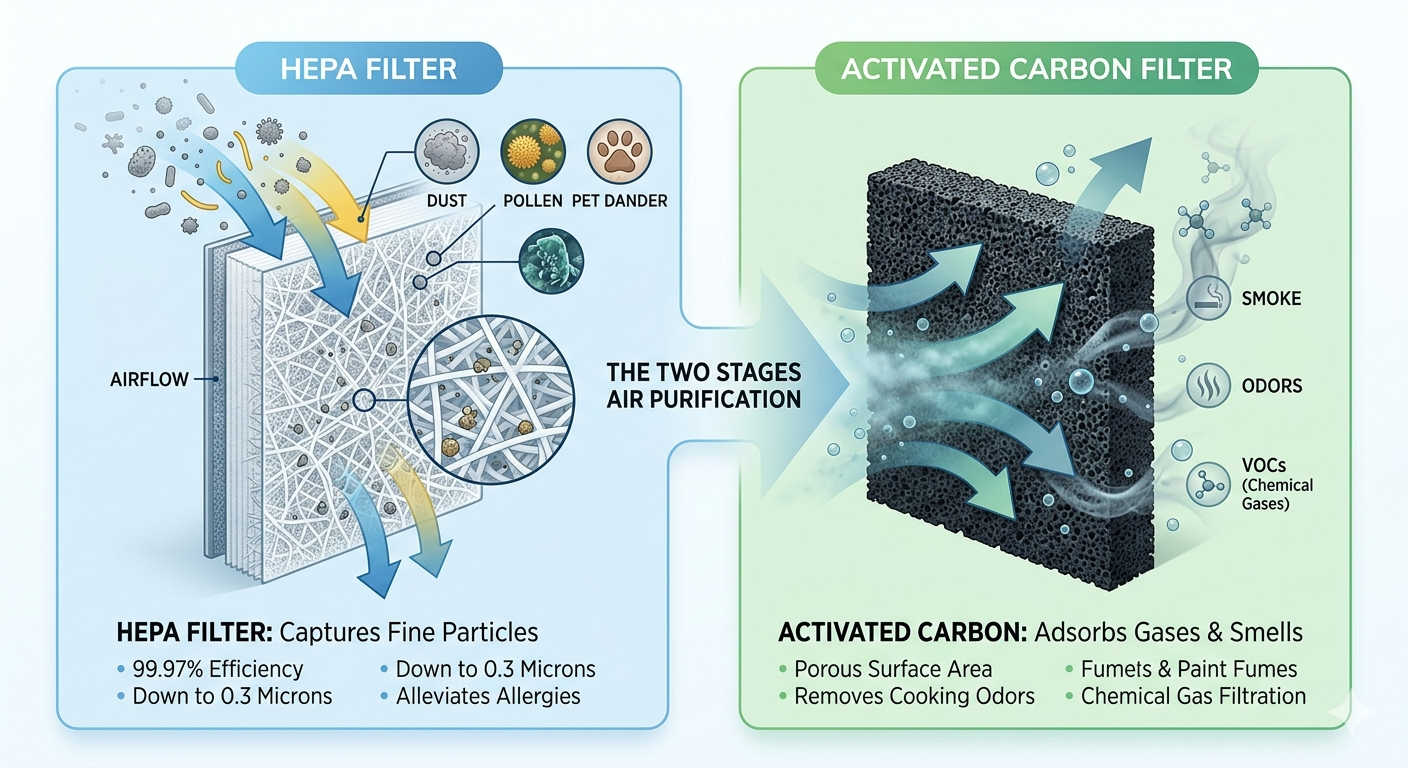
Many people assume these filters perform the same job, but that is not the case. A HEPA filter is designed to capture microscopic particles such as dust and pollen, while an activated carbon filter focuses on removing gases, chemicals, and odors.
Understanding how these filters work—and when you need each one—can help you make a smarter decision when choosing an air purifier or ventilation system.
This guide explains everything you need to know about HEPA filters and activated carbon filters, including how they work, their differences, advantages, limitations, and which option is best for your specific needs.
Understanding HEPA Filters
HEPA stands for High-Efficiency Particulate Air. A HEPA filter is a specialized air filter designed to capture extremely small airborne particles.
True HEPA filters are capable of removing 99.97% of airborne particles as small as 0.3 microns. That level of filtration makes them one of the most effective technologies for improving indoor air quality.
To understand how small these particles are, consider the following comparisons:
- Human hair: about 70 microns
- Dust particles: around 2–10 microns
- Pollen: about 10 microns
- Bacteria: roughly 0.5–5 microns
HEPA filters can capture many of these contaminants before they circulate through your indoor environment.
Because of this high efficiency, HEPA filtration is widely used in hospitals, laboratories, cleanrooms, aircraft ventilation systems, and high-quality air purifiers.
How HEPA Filters Work
A HEPA filter is made of a dense network of randomly arranged fibers, typically constructed from fiberglass or similar materials. When air passes through the filter, particles become trapped inside the fiber structure.
The filtration process occurs through three main mechanisms.
Interception
Smaller airborne particles follow the airflow and stick to the fibers when they come close enough.
Impaction
Larger particles cannot follow the airflow around the fibers. Instead, they collide directly with the fibers and become trapped.
Diffusion
Extremely tiny particles move randomly in the air due to molecular collisions. This unpredictable movement increases the chance that they will collide with the filter fibers and stick.
Together, these mechanisms allow HEPA filters to capture particles across a wide range of sizes.
Pollutants Removed by HEPA Filters
HEPA filters are excellent at removing solid airborne particles, including:
- Dust and fine particulate matter
- Pollen and seasonal allergens
- Pet dander
- Mold spores
- Smoke particles
- Bacteria and some virus-carrying droplets
For people who suffer from allergies, asthma, or respiratory sensitivity, HEPA filtration can significantly improve indoor air quality.
Homes with pets, areas with heavy pollen, or environments with high dust levels benefit greatly from HEPA filtration.
Limitations of HEPA Filters
Despite their impressive particle-removal ability, HEPA filters have an important limitation.
They cannot remove gases, odors, or chemical fumes.
For example, HEPA filters cannot eliminate:
- Cooking smells
- Cigarette smoke odor
- Chemical vapors
- Paint fumes
- Volatile organic compounds (VOCs)
- Household odors
These pollutants exist in gaseous form, which requires a different filtration method. That is where activated carbon filters become useful.
Understanding Activated Carbon Filters
Activated carbon filters are designed specifically to remove gases, odors, and chemical pollutants from the air.
Activated carbon is a highly porous material that has been processed to create millions of microscopic pores. These pores dramatically increase the material’s surface area.
Just a small amount of activated carbon can have an enormous surface area capable of capturing large amounts of chemical molecules.
Activated carbon filters are widely used in many industries, including:
- Air purification systems
- Water filtration systems
- Industrial air treatment
- Gas masks
- Kitchen ventilation systems
Because of their ability to absorb odors and chemical fumes, activated carbon filters are extremely useful for improving indoor air freshness.
How Activated Carbon Filters Work
Activated carbon filters use a process called adsorption.
Unlike absorption—where substances dissolve into another material—adsorption occurs when molecules attach themselves to the surface of another material.
When polluted air passes through an activated carbon filter, gas molecules stick to the carbon’s porous surface. The pollutants remain trapped inside the filter instead of circulating in the air.
This process allows activated carbon filters to capture many types of chemical pollutants and odors.
Pollutants Removed by Activated Carbon Filters
Activated carbon filters are particularly effective at removing gaseous pollutants such as:
- Cooking odors
- Smoke odors
- Pet odors
- Volatile organic compounds (VOCs)
- Paint fumes
- Chemical vapors
- Household cleaning chemical smells
- Industrial gases
These pollutants are commonly released from:
- Furniture and carpets
- Cleaning products
- Paint and building materials
- Cooking activities
- Cigarettes and tobacco products
For homes dealing with unpleasant smells or chemical pollutants, activated carbon filtration can make a noticeable difference.
Limitations of Activated Carbon Filters
Although activated carbon filters are excellent at removing gases and odors, they do not effectively capture airborne particles.
This means they cannot remove:
- Dust
- Pollen
- Pet dander
- Mold spores
- Fine particulate pollution
Another limitation is that carbon filters eventually become saturated. Once the pores fill with trapped pollutants, the filter must be replaced to maintain effectiveness.
Key Differences Between HEPA and Activated Carbon Filters
Understanding the core differences between these two filtration systems makes it easier to decide which one you need.
Filtration Method
HEPA filters rely on mechanical filtration using dense fibers to trap particles.
Activated carbon filters use adsorption to capture gas molecules and chemical pollutants.
Types of Pollutants Removed
HEPA filters remove solid particles like dust, pollen, and smoke particles.
Activated carbon filters remove gases, odors, and chemical vapors.
Best Use Cases
HEPA filters are ideal for allergy control and particulate pollution.
Activated carbon filters are better suited for odor removal and chemical air pollution.
Replacement Needs
HEPA filters typically last longer but gradually clog with particles.
Activated carbon filters must be replaced once their adsorption capacity is exhausted.
Why Many Air Purifiers Use Both Filters
Most modern air purifiers include both HEPA and activated carbon filters.
This combination creates a multi-stage filtration system that can remove a much wider range of indoor pollutants.
A typical air purifier filtration system may include:
- Pre-filter – captures large particles like hair and dust
- HEPA filter – removes microscopic particles and allergens
- Activated carbon filter – removes odors and gases
By combining these technologies, air purifiers can deliver cleaner, fresher indoor air.
Recommended Air Purifiers with HEPA and Carbon Filters
When choosing an air purifier, selecting a model that includes both filtration technologies provides the best results.
Some highly regarded options include:
Coway Airmega 200M
A popular air purifier known for strong filtration performance and quiet operation. It uses a multi-stage system including a HEPA filter and an activated carbon layer.
Levoit Core 300
A compact and affordable purifier that combines HEPA filtration with carbon filtration. It works well for bedrooms and small living spaces.
Blueair Blue Pure 211i Max
Designed for larger rooms, this purifier includes particle filtration along with an activated carbon component for odor removal.
Winix 5510
A well-balanced air purifier that includes HEPA filtration, carbon filtration, and additional purification technologies.
When choosing a purifier, consider room size, filter replacement costs, and airflow performance.
When You Should Choose a HEPA Filter
A HEPA filter is the best choice if your main concern is airborne particles.
You may need HEPA filtration if you want to reduce:
- Dust accumulation
- Allergens
- Pet dander
- Pollen exposure
- Mold spores
HEPA filtration is especially beneficial for people with allergies or respiratory conditions.
When an Activated Carbon Filter Is More Important
Activated carbon filtration is most useful when odors or chemical pollutants are your main concern.
This filter type is ideal for situations such as:
- Removing cooking smells
- Eliminating cigarette smoke odor
- Reducing paint fumes
- Removing chemical smells from cleaning products
- Improving air freshness in kitchens or pet areas
In homes with noticeable odors, carbon filtration can dramatically improve air quality.
Tips for Choosing the Right Air Filtration System
Before purchasing an air purifier or filter system, consider these factors.
Identify Your Main Air Quality Problem
Determine whether you are dealing primarily with particles, odors, or both.
Check the Room Size Coverage
Choose a purifier rated for the size of your room to ensure effective air cleaning.
Consider Filter Replacement Costs
Some filters must be replaced several times per year, so ongoing costs are important.
Look for True HEPA Certification
Not all filters labeled “HEPA-type” meet official HEPA standards.
Ensure Adequate Carbon Content
More activated carbon generally means better odor and gas removal.
Common Misconceptions About HEPA and Carbon Filters
Several myths about air filtration can lead to confusion.
Myth: HEPA Filters Remove Odors
HEPA filters capture particles but do not remove odors or gases.
Myth: Carbon Filters Remove Dust
Activated carbon filters focus on gases and odors, not solid particles.
Myth: One Filter Is Better Than the Other
Both technologies serve different purposes and work best when used together.
Frequently Asked Questions
Do I need both HEPA and activated carbon filters?
Yes. Using both filters provides the most complete air purification because they target different types of pollutants.
Can HEPA filters remove viruses?
HEPA filters can capture many virus-carrying droplets, although they are primarily designed for particle filtration.
How often should air purifier filters be replaced?
Most HEPA filters last between 6 and 12 months, while carbon filters may require replacement every 3 to 6 months depending on air quality.
Are air purifiers worth buying?
Air purifiers can significantly improve indoor air quality, especially for people with allergies, pets, or exposure to pollution.
Do carbon filters remove cigarette smoke?
Activated carbon filters can remove the odor of cigarette smoke, while HEPA filters capture smoke particles.
Final Thoughts
HEPA filters and activated carbon filters are both essential technologies for improving indoor air quality, but they solve different problems.
HEPA filters excel at removing airborne particles such as dust, pollen, and allergens. Activated carbon filters specialize in eliminating odors, chemical fumes, and harmful gases.
Instead of choosing one over the other, the most effective solution is a combined filtration system that includes both technologies.
By understanding how these filters work and what pollutants they target, you can select the right air purifier or filtration system to create a cleaner, healthier indoor environment.
You might also like,
- 10 Easy Ways to Reduce Allergies at Home | Allergy-Friendly Living
- 12 Energy-Saving Tips for Your HVAC System to Lower Bills in 2026
- 2025 HVAC Tax Credits and Rebates: Ultimate Savings Guide for Homeowners
- Are Air Purifier Replacement Filters Worth It? Cost, Benefits & Best Picks (2026)
- Best Air Purifiers for Dust Mites and Pet Dander in 2026: Top Picks for Allergy Relief