
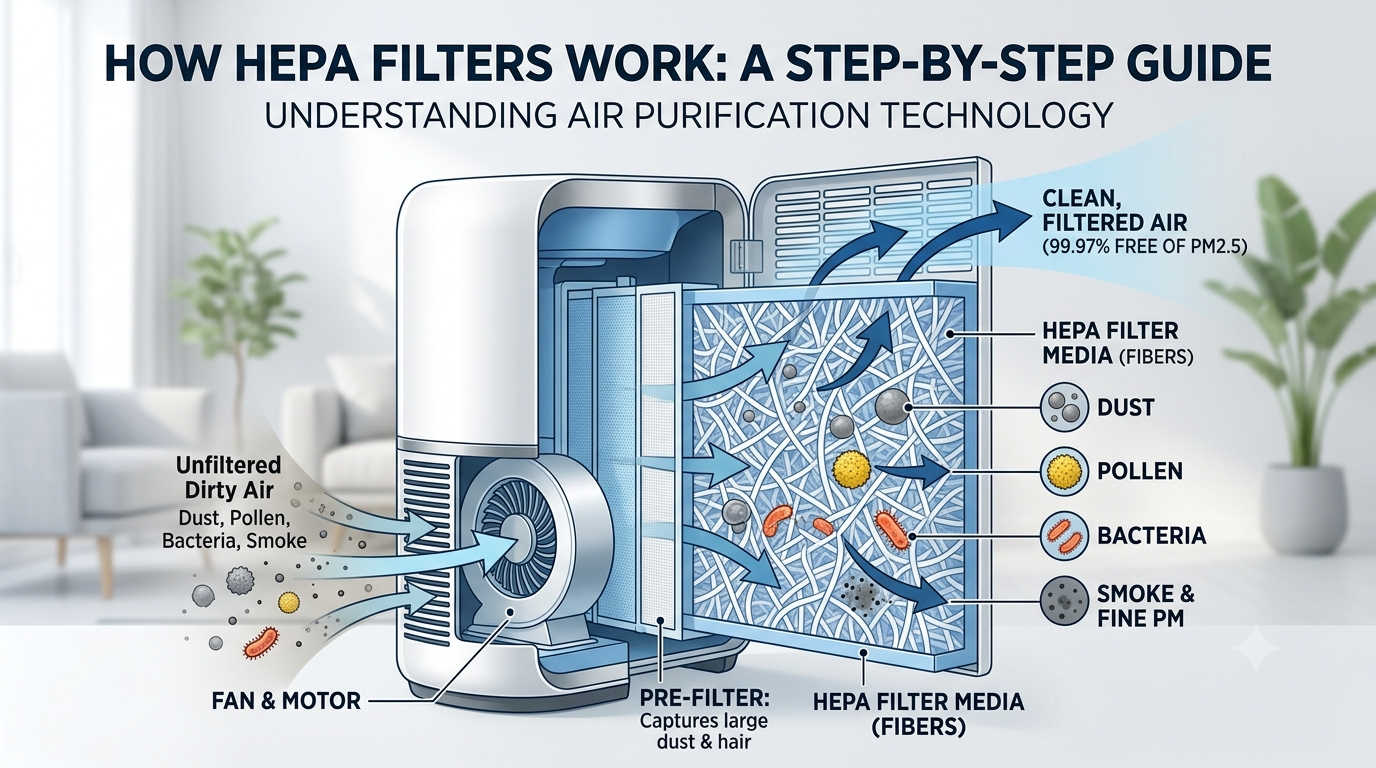
Clean indoor air has become a priority for many households, workplaces, and healthcare environments. Dust, pollen, smoke, bacteria, and microscopic particles constantly circulate through the air we breathe. In enclosed spaces, these contaminants can accumulate quickly and negatively affect comfort, health, and productivity.
Air purifiers have become a popular solution to address indoor air pollution, and at the heart of many high-quality purifiers is the HEPA filter. This technology has been trusted for decades in hospitals, laboratories, aircraft cabins, and homes because of its ability to capture extremely small airborne particles.
But many people misunderstand how HEPA filters actually work. Some believe they simply act like fine screens that block particles, while others assume they eliminate all forms of pollution. The reality is far more interesting. HEPA filtration relies on several physical processes working together to trap contaminants that are invisible to the human eye.
In this guide, you’ll learn how HEPA filters function, the science behind their filtration efficiency, the types of pollutants they capture, and how to choose the right HEPA air purifier for your needs.
What Is a HEPA Filter?
HEPA stands for High-Efficiency Particulate Air. A filter must meet strict performance standards to be classified as a true HEPA filter.
A genuine HEPA filter is designed to remove 99.97% of airborne particles that measure 0.3 microns in diameter.
To understand how small that is:
- Human hair: about 50–70 microns wide
- Fine dust: roughly 2.5 microns
- Bacteria: around 0.5–5 microns
- Smoke particles: often less than 1 micron
This means HEPA filters can capture particles far smaller than what our eyes can see.
Interestingly, the 0.3-micron benchmark is not the smallest particle HEPA filters can capture. Instead, it represents the most difficult particle size to filter, known as the most penetrating particle size. If a filter performs well at this size, it usually performs even better at filtering both larger and smaller particles.
Because of this capability, HEPA filtration is considered one of the most reliable methods of removing particulate pollutants from indoor air.
The Basic Structure of a HEPA Filter
At first glance, a HEPA filter may look like a simple pleated sheet. However, its internal structure is far more sophisticated.
A HEPA filter consists of a dense network of randomly arranged fibers, typically made from materials such as fiberglass or specialized synthetic polymers. These fibers are extremely thin—often only a few microns in diameter.
Instead of forming straight passages for air to flow through, the fibers create a complex maze. As air passes through this maze, airborne particles encounter multiple obstacles that increase the likelihood of being captured.
This design accomplishes several important things:
- It creates thousands of twisting air channels.
- It increases surface area for particle capture.
- It forces particles to interact repeatedly with filter fibers.
Because the fibers are arranged irregularly, particles cannot simply travel in a straight line through the filter. They are constantly redirected, slowed down, or forced into contact with the fibers.
This structure enables HEPA filters to capture particles using several physical mechanisms at the same time.
The Science Behind HEPA Filtration
HEPA filters remove particles from the air through three primary mechanisms:
- Impaction
- Interception
- Diffusion
Each mechanism targets different particle sizes, which is why HEPA filters are effective across a broad range of contaminants.
Impaction: Capturing Larger Particles
Impaction primarily affects larger airborne particles such as:
- Dust
- Mold spores
- Pollen
- Pet dander
When air flows through the filter, it must bend and curve around the fibers. Larger particles, however, have greater mass and momentum. Because of their inertia, they cannot easily follow the changing airflow paths.
Instead of moving with the air, these particles continue traveling in a straight line until they collide with a fiber. Once they strike the fiber, they become trapped.
This process is similar to a fast-moving car that struggles to follow a sharp turn. The heavier the object, the harder it is to change direction quickly.
As a result, large particles are efficiently removed from the air through direct collision with the filter fibers.
Interception: Capturing Medium-Sized Particles
Interception works differently and primarily captures particles in the medium size range.
These particles are small enough to follow the airflow through the filter. However, if they pass close enough to a fiber—within one particle radius—they touch the fiber and stick to it.
Once contact occurs, weak molecular forces help hold the particle in place.
Particles commonly captured through interception include:
- Fine dust
- Pet allergens
- Smoke particles
- Some bacteria
Although interception may sound subtle, it plays a major role in removing particles that are too small to be affected by impaction but too large for diffusion to dominate.
Diffusion: Capturing Ultrafine Particles
Diffusion is the primary mechanism responsible for capturing extremely small particles.
Ultrafine particles behave differently than larger particles because they constantly collide with surrounding air molecules. These collisions cause the particles to move randomly in a zigzag pattern, a phenomenon known as Brownian motion.
Because of this erratic movement, ultrafine particles do not travel in straight paths. Instead, they wander unpredictably through the filter.
This random motion increases the probability that the particle will eventually collide with a fiber and stick to it.
Diffusion is particularly effective for trapping:
- Smoke particles
- Combustion pollutants
- Ultrafine dust
- Many viruses
Ironically, the smallest particles can sometimes be easier to capture than medium-sized particles because their chaotic motion increases the chance of contact with filter fibers.
Why the 0.3 Micron Size Is Important
The 0.3-micron particle size is considered the most challenging particle size for filtration.
Particles larger than this are efficiently captured through impaction and interception. Particles smaller than this tend to move randomly due to diffusion, making them easier to trap.
Particles around 0.3 microns fall into a transitional range where none of the three mechanisms dominate strongly. Because they are harder to capture, filtration standards use this size as the benchmark for testing HEPA filters.
If a filter can remove 99.97% of these difficult particles, it will perform even better with most other particle sizes.
Pollutants HEPA Filters Can Remove
HEPA filters are extremely effective at removing particulate pollutants from indoor air.
Common contaminants captured by HEPA filtration include:
- Household dust
- Pollen and seasonal allergens
- Pet dander
- Mold spores
- Smoke particles
- Fine particulate pollution (PM2.5)
- Some bacteria and microorganisms
These pollutants are among the most common causes of allergies, respiratory irritation, and poor indoor air quality.
However, it is important to note that HEPA filters do not remove gases or odors. Pollutants such as volatile organic compounds (VOCs), cooking fumes, and chemical vapors require additional filtration technologies like activated carbon.
Where HEPA Filters Are Used
Because of their high efficiency, HEPA filters are used in many critical environments.
Homes and Apartments
Many residential air purifiers rely on HEPA filters to improve indoor air quality. They help remove allergens, dust, and smoke that accumulate in enclosed spaces.
This makes them especially useful for:
- Allergy sufferers
- Pet owners
- Urban households exposed to pollution
Hospitals and Medical Facilities
Healthcare environments require extremely clean air to prevent contamination and airborne infections.
HEPA filtration is commonly used in:
- Operating rooms
- Isolation wards
- Intensive care units
- Medical laboratories
Aircraft Cabins
Modern aircraft use HEPA filtration systems to clean cabin air during flights. These systems remove airborne particles and help maintain air quality even when hundreds of passengers share the same space.
Cleanrooms and Laboratories
Industries such as semiconductor manufacturing, biotechnology, and pharmaceuticals require ultra-clean environments where even microscopic contamination can cause problems.
HEPA filters help maintain these controlled environments by removing airborne particles from ventilation systems.
Recommended HEPA Air Purifiers
If you’re considering improving indoor air quality, choosing a reliable air purifier with a true HEPA filter is important. Below are several well-known options that offer strong performance and good value.
Coway Airmega AP-1512HH Mighty
This air purifier is widely praised for its strong filtration performance and compact design. It uses a four-stage filtration system that includes a true HEPA filter and an activated carbon layer for odors.
It is suitable for medium-sized rooms and operates quietly, making it ideal for bedrooms and living spaces.
Levoit Core 300
The Levoit Core 300 is a popular option for small to medium rooms. It uses a three-stage filtration system with a true HEPA filter designed to capture fine particles such as dust, pollen, and smoke.
Its compact size and affordable price make it a good entry-level choice for many households.
Blueair Blue Pure 211i Max
For larger rooms, the Blue Pure 211i Max offers powerful airflow and high filtration efficiency. It combines mechanical filtration with electrostatic technology to capture airborne particles effectively.
This model is particularly useful for open living spaces or areas with heavy air pollution.
Tips for Choosing the Right HEPA Air Purifier
When selecting a HEPA air purifier, consider the following factors.
Room Size
Air purifiers are designed to handle specific room sizes. Always check the recommended coverage area to ensure the purifier can effectively clean the air in your space.
Clean Air Delivery Rate (CADR)
CADR measures how quickly an air purifier removes pollutants from the air. Higher CADR values indicate faster air cleaning performance.
Noise Levels
Some air purifiers can be loud at high fan speeds. If you plan to use the device in a bedroom or workspace, look for models with quiet or sleep modes.
Filter Replacement Cost
HEPA filters need periodic replacement. Before purchasing a purifier, check how often the filters must be replaced and how much they cost.
Maintaining a HEPA Filter
Proper maintenance is essential for keeping a HEPA air purifier working efficiently.
Over time, captured particles accumulate within the filter media. As the filter becomes clogged, airflow may decrease and the purifier may work harder to move air through the system.
Most manufacturers recommend replacing HEPA filters every 6 to 12 months, depending on usage and environmental conditions.
Regular maintenance ensures consistent air purification and prolongs the lifespan of the device.
Common Myths About HEPA Filters
Several misconceptions surround HEPA filtration technology.
HEPA Filters Kill Germs
HEPA filters do not kill microorganisms. They simply trap them within the filter fibers. Some air purifiers include UV-C light or antimicrobial coatings to address this issue.
HEPA Filters Remove All Air Pollution
HEPA filtration removes particulate matter but cannot eliminate gases, odors, or chemical vapors. Additional filters such as activated carbon are required for those pollutants.
All HEPA Filters Are the Same
Not all filters labeled “HEPA-type” or “HEPA-like” meet the official performance standard. Only true HEPA filters are tested to remove 99.97% of particles at 0.3 microns.
The Future of Air Filtration Technology
Air filtration technology continues to evolve as researchers develop new materials and designs to improve performance.
Emerging innovations include:
- Nanofiber filtration media
- Smart air purification systems with sensors
- Self-cleaning filters
- Hybrid filtration combining HEPA and advanced carbon systems
These advancements aim to improve air purification efficiency while reducing energy consumption and maintenance costs.
Frequently Asked Questions (FAQs)
Do HEPA filters remove viruses?
HEPA filters can capture many virus-containing particles because viruses typically travel on droplets or aerosols that fall within the filter’s capture range.
How long does a HEPA filter last?
Most HEPA filters last between 6 and 12 months depending on usage, air quality, and manufacturer recommendations.
Are HEPA air purifiers worth it?
For people with allergies, asthma, pets, or exposure to pollution, HEPA air purifiers can significantly improve indoor air quality and comfort.
Can HEPA filters remove smoke?
Yes. HEPA filters can capture fine smoke particles. However, odors from smoke may require an activated carbon filter to remove effectively.
What is the difference between HEPA and HEPA-type filters?
True HEPA filters meet strict efficiency standards. HEPA-type filters may look similar but usually capture fewer particles.
Final Thoughts
HEPA filters remain one of the most trusted technologies for improving indoor air quality. Their effectiveness comes from a sophisticated combination of physical processes that capture particles across a wide range of sizes.
By understanding how HEPA filtration works, consumers can make better decisions when choosing air purifiers and maintaining healthy indoor environments.
Whether used in homes, hospitals, aircraft cabins, or laboratories, HEPA filters play an essential role in reducing airborne contaminants and protecting the air we breathe every day.
You might also like,
Best HEPA Air Purifiers 2026: Top Picks for Cleaner Indoor Air
Best HEPA Air Purifiers for Home Large Rooms (2026 Buyer’s Guide)
Best HEPA Air Purifiers for Bedrooms (2026): Sleep Better & Breathe Cleaner Air
Best HEPA Air Purifier for Pet Allergies in 2026 – Top Picks for Cleaner Indoor Air

