
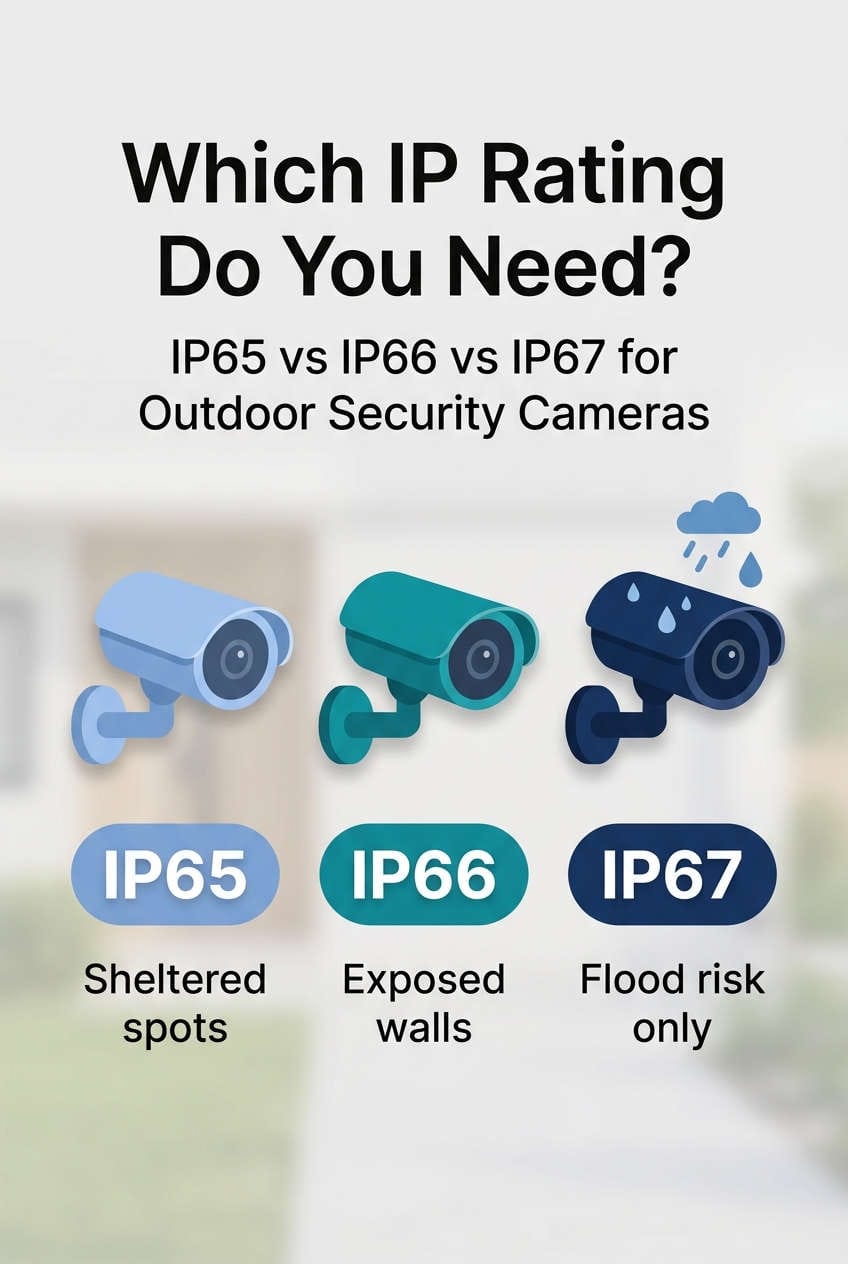
If you’ve spent any time shopping for an outdoor security camera, you’ve probably run into specs like IP65, IP66, or IP67 and wondered what they actually mean for your home. It’s easy to assume the bigger number is always the better buy, but that logic can lead you to overspend on protection you don’t need or, worse, leave a camera exposed to weather it was never built to handle.
The truth is simpler than the marketing suggests. The right IP rating depends entirely on where you plan to mount the camera. A unit tucked under a porch roof has very different needs from one bolted to an open fence post in the path of driving rain. This guide breaks down what each rating really means, where each one makes sense, and how to avoid the most common mistakes buyers make.
What the IP Code Actually Tells You
IP stands for Ingress Protection, and it’s an international standard that describes how well a device keeps out solid objects and water. The rating always appears as two digits.
The first digit covers solids. For IP65, IP66, and IP67, that digit is always 6, which means the camera is completely dust-tight. No dust gets inside to fog up the lens or contaminate the sensor, which matters a lot for equipment that stays outside year-round.
The second digit covers water, and that’s where these three ratings part ways. It ranges from light splashes all the way up to temporary submersion. Understanding that second digit is the key to choosing wisely.
IP65: Solid Protection for Sheltered Spots
An IP65 camera can handle low-pressure water jets from any direction. In everyday terms, that means it shrugs off normal rain, humidity, and the occasional splash without any trouble. What it isn’t built for is high-pressure spray, like a direct hit from a garden hose nozzle or a pressure washer, and it should never be submerged.
This rating is the practical baseline for outdoor use. If your camera sits under a porch roof, an eave, or any kind of overhang where it’s shielded from wind-driven rain, IP65 does the job well and usually costs less. There’s no sense paying for extra water protection the camera will never encounter.
IP66: The Right Fit for Most Homes
IP66 raises the bar to withstand powerful water jets from any angle. The testing here simulates stronger, higher-pressure streams, which is exactly what a camera faces when a storm drives rain sideways into an exposed wall.
For most homeowners, this is the sweet spot. If you’re mounting a camera on an open exterior wall, a fence post, or above a driveway where it takes the full force of the weather with no shelter at all, IP66 gives you a meaningful margin of safety. It’s the rating that matches the reality of an average suburban or rural installation.
IP67: More Than Most People Need
IP67 includes everything IP66 offers and adds protection against temporary submersion in up to a meter of water for about half an hour. That sounds impressive, and it is, but it’s worth understanding what it doesn’t mean. An IP67 camera isn’t necessarily better at resisting forceful rain than an IP66 model. It’s simply built to survive a brief dunking, such as falling into a puddle or sitting in rising floodwater.
For the vast majority of home setups, IP67 is overkill. You’d only genuinely benefit if the camera sits very low to the ground in a flood-prone area, or if standing water is a realistic threat where you live. Otherwise, you’re paying a premium for a scenario that likely won’t happen.
Why a Higher Number Isn’t Automatically Better
One of the most persistent myths in camera shopping is that IP67 beats IP66 beats IP65 across the board. In reality, IP66 is tested against more forceful water jets than IP67. So if your camera faces a driving rainstorm on an exposed wall, the IP66 rating is arguably the more relevant one, because the threat is the force of water striking the housing, not the device sitting in a pool.
It’s also important to remember that an IP rating says nothing about overall build quality. A bargain-bin IP67 camera with a flimsy seal around the SD card slot will fail long before a well-made IP65 unit from a brand that knows what it’s doing. The rating only holds up when every port and cover is properly closed, so check those seals before you trust the number on the box.
Practical Tips That Matter as Much as the Rating
The IP number is the headline spec, but a few real-world details often decide whether a camera survives its first winter.
- Angle the camera slightly downward. Even a well-sealed IP66 unit can develop problems if it points straight up, because water pools around the lens and seals instead of running off.
- Watch for condensation. IP ratings address water coming in from outside, not moisture trapped inside from temperature swings between warm days and cold nights. In humid climates, look for cameras with breathable membranes or desiccant packs.
- Check the operating temperature range. A camera can keep every drop of rain out and still fail in a hard freeze if its electronics or battery aren’t rated for the cold. Always look at the temperature specs alongside the IP rating.
- Keep access ports sealed. Charging ports and SD card slots are the most common entry points for water. Make sure the rubber gaskets are seated properly after setup and check them occasionally.
A Simple Way to Choose
Matching your mounting location to the rating takes the guesswork out of the decision.
- Under an eave, porch, or carport? Go with IP65. It handles indirect moisture and saves you money.
- On an open wall, fence, or exposed soffit? Go with IP66. The extra jet protection is worth it for storm resilience.
- Near ground level in a flood zone? Go with IP67. Choose it only if submersion is a real risk, not just rainfall.
For most standard home installations, where a camera faces the open sky but never standing water, IP66 is the most practical and dependable choice. It covers the weather you’ll actually see without charging you for protection against floods that probably won’t reach your lens.
Frequently Asked Questions
Is IP67 always better than IP66 for rain?
No. IP66 is tested against stronger water jets than IP67, so for exposed walls and driving storms, IP66 is often the more relevant rating. IP67’s advantage is submersion, not spray.
Can I use an IP65 camera in full rain?
Yes, as long as it has some shelter. IP65 handles normal rain and splashes fine, but it isn’t designed for high-pressure jets or long-term direct exposure to wind-driven storms.
Does a higher IP rating mean a longer-lasting camera?
Not necessarily. Build quality, seal integrity, and temperature tolerance matter just as much. A well-made IP65 camera can easily outlast a cheap IP67 model.
Do I need IP67 for a camera near a pool or sprinkler?
Probably not. Splashing and spray are covered by IP65 or IP66. IP67 only becomes useful if the camera could actually be submerged.
What if my camera’s ports get wet?
Dry the unit thoroughly, make sure the gaskets are clean and seated, and avoid powering it on until it’s fully dry. Repeated moisture at the ports usually points to a worn seal that needs replacing.
You might also like,