
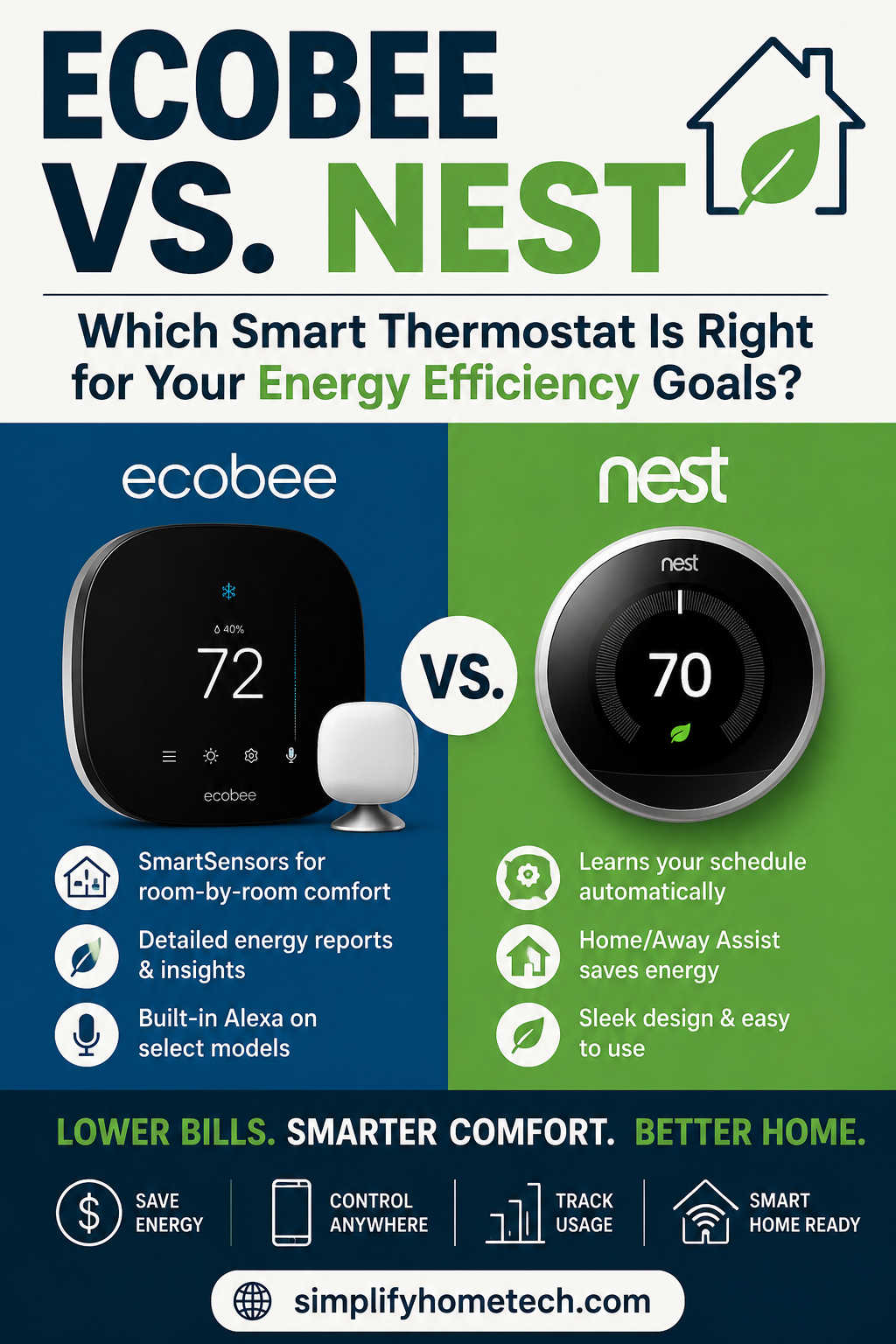
Smart thermostats have become one of the easiest and most effective upgrades for homeowners looking to improve comfort while reducing energy costs. Instead of relying on fixed schedules or manual temperature adjustments, these intelligent devices learn your routines, detect when you’re home or away, and optimize heating and cooling automatically.
Among today’s leading smart thermostats, Ecobee and Google Nest consistently stand out. Both offer advanced automation, smartphone control, and energy-saving features, but they approach home climate management differently.
So, which one is the better investment?
The answer depends on your home, lifestyle, and smart home ecosystem. In this detailed comparison, we’ll break down the differences between Ecobee and Nest, compare their features, discuss real-world energy savings, and help you choose the thermostat that best aligns with your energy efficiency goals.
Why a Smart Thermostat Is Worth the Upgrade
Heating and cooling account for one of the largest portions of a household’s electricity bill. A traditional thermostat only follows the schedule you program, while a smart thermostat actively adapts to your habits and environmental conditions.
The biggest benefits include:
- Lower monthly energy bills
- Better indoor comfort
- Automatic scheduling
- Remote control through a mobile app
- Occupancy detection
- Smart home integration
- Energy usage insights
- Weather-based temperature adjustments
Many homeowners recover the purchase price within a few years through reduced heating and cooling costs, making a smart thermostat one of the most cost-effective smart home upgrades available.
Ecobee vs. Nest at a Glance
| Feature | Ecobee | Google Nest |
|---|---|---|
| Best For | Large homes and room-by-room comfort | Automated scheduling and simplicity |
| Smart Sensors | Included on many models | Optional on select models |
| Learning Schedule | Manual with smart optimization | Automatic self-learning |
| Voice Assistant | Alexa built into select models | Google Assistant integration |
| Apple HomeKit | Excellent support | Limited support |
| Google Home | Yes | Excellent |
| Energy Reports | Detailed | Basic |
| Ease of Use | Highly customizable | Beginner-friendly |
Understanding the Ecobee Smart Thermostat
Ecobee focuses on maximizing comfort throughout your entire home rather than controlling the temperature from a single location.
One of its standout features is the SmartSensor. Instead of relying only on the thermostat’s built-in temperature sensor, Ecobee monitors occupancy and temperature in multiple rooms. This helps eliminate common problems such as hot upstairs bedrooms or cold living rooms.
For households where family members spend time in different parts of the home throughout the day, this feature can make a noticeable difference in both comfort and efficiency.
Key Features
- SmartSensors included with premium models
- Large responsive touchscreen
- Occupancy detection
- Detailed energy reports
- Built-in Alexa on select models
- Broad smart home compatibility
- Power Extender Kit for homes without a C-wire
Ecobee is particularly well suited to medium and large homes where temperatures vary between rooms.
Understanding the Google Nest Thermostat
Google designed Nest with one goal in mind: automation.
Instead of asking users to manually create heating and cooling schedules, Nest observes your daily routine. Within a few days, it begins adjusting temperatures automatically based on when you wake up, leave for work, return home, and go to bed.
This “set it and forget it” philosophy makes Nest especially appealing for homeowners who want smart technology without spending time configuring every detail.
Key Features
- Auto-learning schedule
- Home/Away Assist
- Sleek circular design
- Smartphone control
- Weather-aware adjustments
- Google Home integration
- Seasonal energy-saving suggestions
Nest is ideal for users who want convenience with minimal maintenance.
Design and User Experience
Ecobee
Ecobee features a modern rectangular touchscreen similar to a smartphone.
Advantages include:
- Large display that’s easy to read
- Simple menu navigation
- Weather forecasts displayed directly on screen
- Quick access to settings
The touchscreen interface feels familiar and intuitive for most users.
Nest
Nest takes a different approach with its iconic circular design.
Users rotate the outer ring to navigate menus and press it to make selections.
The interface is minimalist, elegant, and visually appealing.
Which Design Is Better?
If aesthetics are your top priority, Nest wins with its premium appearance.
If usability and readability matter more, Ecobee’s larger touchscreen offers a better everyday experience.
Installation: Which Is Easier?
Both thermostats are designed for DIY installation, and most homeowners can complete the process in under an hour.
Each brand provides step-by-step instructions through its mobile app, making setup straightforward even for beginners.
Ecobee Installation
Pros:
- Excellent installation guide
- Supports a wide variety of HVAC systems
- Includes a Power Extender Kit for homes without a C-wire
Nest Installation
Pros:
- Simple wiring process
- Quick setup
- Clean installation interface
Installation Verdict
Both products are easy to install, making this category essentially a tie.
Energy Efficiency Comparison
Energy savings are the main reason most homeowners invest in a smart thermostat.
Both Ecobee and Nest can significantly reduce heating and cooling costs, but they achieve this in different ways.
How Ecobee Saves Energy
Ecobee focuses on occupancy-based climate control.
Its SmartSensors identify occupied rooms and prioritize comfort where people actually are instead of maintaining identical temperatures throughout the house.
Additional energy-saving features include:
- Smart Recovery
- Follow Me occupancy detection
- Intelligent scheduling
- Utility rebate eligibility
- Energy usage reports
This approach is particularly effective in larger homes.
How Nest Saves Energy
Nest relies heavily on artificial intelligence and automation.
Its most popular features include:
Auto Schedule
Nest automatically creates heating and cooling schedules based on your daily habits.
Home/Away Assist
Using motion detection and your smartphone’s location, Nest switches to energy-saving temperatures whenever nobody is home.
Seasonal Savings
Nest occasionally recommends small schedule adjustments that help reduce utility bills without noticeably affecting comfort.
Leaf Indicator
Whenever you select an energy-efficient temperature, the famous green Leaf appears as a simple reminder that you’re making an efficient choice.
Which Thermostat Saves More Energy?
In real-world conditions, both thermostats typically help homeowners reduce heating and cooling costs by approximately 10%–20%, although actual savings depend on climate, insulation, HVAC efficiency, and personal habits.
Generally speaking:
- Ecobee performs better in larger homes with varying room temperatures.
- Nest performs better for homeowners who prefer automatic scheduling with minimal interaction.
Smart Home Compatibility
Your existing smart home ecosystem plays a major role in choosing the right thermostat.
Ecobee Compatibility
Ecobee supports:
- Apple HomeKit
- Amazon Alexa
- Google Assistant
- Samsung SmartThings
- IFTTT
Its broad compatibility makes it one of the most flexible smart thermostats available.
Nest Compatibility
Nest works exceptionally well with:
- Google Home
- Google Assistant
- Google ecosystem devices
Although it supports Alexa through integrations, Apple HomeKit compatibility remains limited.
Winner
Choose Ecobee if you use multiple smart home platforms.
Choose Nest if your home is already centered around Google products.
Mobile App Comparison
Ecobee App
The Ecobee app offers advanced controls, including:
- Detailed energy history
- Remote temperature adjustment
- Vacation mode
- Sensor management
- HVAC performance monitoring
It provides extensive customization for users who enjoy fine-tuning their system.
Google Home App
Nest management is now integrated primarily into the Google Home app.
The interface is clean and beginner-friendly while offering essential features such as:
- Temperature control
- Schedule editing
- Notifications
- Energy history
App Verdict
Ecobee offers more detailed controls.
Nest delivers a simpler, cleaner experience.
Smart Sensors: A Major Difference
One of the biggest differences between these thermostats is room sensing.
Ecobee SmartSensors
Ecobee’s SmartSensors detect:
- Room temperature
- Occupancy
- Movement
This allows the thermostat to maintain comfort where people actually spend time.
For homes with multiple floors or inconsistent temperatures, SmartSensors are one of Ecobee’s biggest advantages.
Nest Temperature Sensors
Google offers optional temperature sensors with select models.
While helpful, they don’t provide the same level of occupancy-based automation found in Ecobee’s ecosystem.
Winner
Ecobee clearly leads in room-by-room climate management.
Pricing and Overall Value
Pricing varies throughout the year, but both brands offer models across different price points.
Ecobee
Best for buyers looking for premium features such as SmartSensors, advanced reporting, and broader smart home compatibility.
Nest
Offers both budget-friendly and premium models, making it easier to find an option that fits different budgets.
When considering value, remember to factor in long-term energy savings and potential utility rebates, which can significantly reduce the overall cost of ownership.
Which Smart Thermostat Should You Buy?
Choosing the right thermostat depends on your home’s layout, your daily routine, and the smart home devices you already own.
Choose Ecobee If
Ecobee is the better choice if you:
- Live in a medium or large home
- Have rooms that are often too hot or too cold
- Want detailed energy reports
- Prefer advanced customization
- Use Apple HomeKit
- Need precise room-by-room comfort
Choose Google Nest If
Nest is the better option if you:
- Want the thermostat to learn your schedule automatically
- Already use Google Home devices
- Prefer a simple, hands-off experience
- Appreciate minimalist design
- Want an easy installation process
Final Recommendation
Both Ecobee and Google Nest are outstanding smart thermostats capable of reducing energy consumption while improving everyday comfort. Neither is objectively better for every household—the right choice depends on your priorities.
Choose Ecobee if your focus is maximizing comfort throughout your home. Its SmartSensors, detailed energy reports, and broad compatibility make it an excellent investment for larger homes, families, and users who enjoy having greater control over their heating and cooling system.
Choose Google Nest if you want effortless automation. Its self-learning technology, elegant design, and seamless integration with the Google ecosystem make it an ideal choice for homeowners who prefer a thermostat that quietly manages energy efficiency in the background.
For most households concerned with whole-home comfort and long-term energy efficiency, Ecobee offers the strongest overall value. However, if convenience and simplicity are your top priorities, Google Nest remains one of the smartest and most user-friendly thermostats you can buy.
Frequently Asked Questions
Is Ecobee better than Nest for saving energy?
Both thermostats can significantly reduce heating and cooling costs. Ecobee often performs better in larger homes because its SmartSensors manage temperatures across multiple rooms, while Nest excels through automated scheduling and occupancy detection.
Do smart thermostats really lower electricity bills?
Yes. Most homeowners experience noticeable savings by reducing unnecessary heating and cooling when the house is empty and optimizing temperature schedules throughout the day.
Which thermostat is easier for beginners?
Google Nest is generally easier for first-time users because it automatically learns your routine and requires very little manual setup after installation.
Does Ecobee work without a C-wire?
Many Ecobee models include a Power Extender Kit that allows installation in homes without a traditional C-wire, making it compatible with a wider range of HVAC systems.
Which thermostat is best for larger homes?
Ecobee is usually the better choice for larger or multi-story homes thanks to its SmartSensors, which help maintain consistent temperatures in occupied rooms instead of relying on a single thermostat location.
You might also like,