
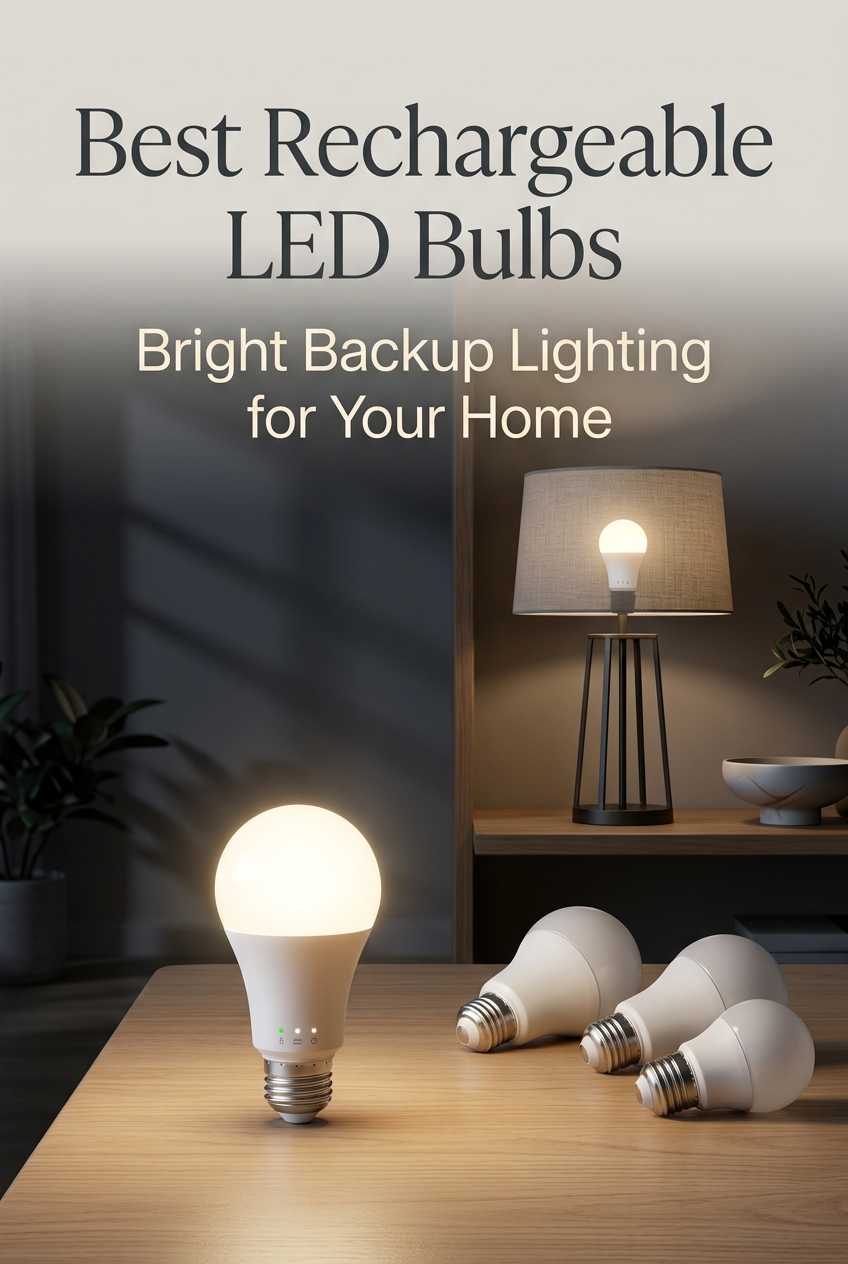
A power outage can turn an ordinary evening into a frustrating scramble for flashlights and candles. Even a short blackout becomes inconvenient when you’re cooking, working, walking through a hallway, or trying to find something in a dark room.
Rechargeable LED bulbs offer a simple solution. They work like ordinary household bulbs while the electricity is on, but their built-in batteries can provide backup illumination when the power fails. Some models switch on automatically during an outage, while others can be removed and used as portable lights.
The challenge is choosing a model that offers useful brightness, dependable battery life, convenient charging, and the right socket compatibility without paying for features you don’t need.
This guide looks at the best rechargeable LED bulbs for home use in 2026, explains what separates a good emergency bulb from a mediocre one, and highlights suitable options for different rooms and priorities.
Best Rechargeable LED Bulbs for Home Use
The best rechargeable LED bulb depends on how you plan to use it. Some are designed primarily for emergency lighting, while others add dimming, remote control, adjustable color temperature, or portable operation.
GE LED+ Battery Backup Bulb: Best Overall
The GE LED+ Battery Backup is a strong choice for anyone who wants straightforward emergency lighting without changing the way they normally use a light fixture.
It is designed to function like a conventional LED bulb during normal operation while keeping its internal battery ready for a power interruption. That makes it particularly suitable for living rooms, bedrooms, hallways, and other frequently used areas.
Its biggest advantage is simplicity. You install the bulb in a compatible fixture and don’t need a separate emergency lamp occupying space on a shelf.
It is a good option for homeowners who value dependable, uncomplicated backup lighting more than advanced smart features.
Best for: General household emergency lighting.
Consider another option if: You need particularly long battery runtime or want extensive color and brightness controls.
Neporal LITE PRO: Best for Extended Backup
The Neporal LITE PRO is worth considering when battery performance is more important than having the simplest possible bulb.
Its rechargeable design and multiple brightness settings allow you to balance illumination against battery consumption. During a short outage, you can use a higher setting. If the electricity remains off for several hours, reducing brightness can help stretch the available charge.
That flexibility makes it useful in homes where outages aren’t always brief.
It can work particularly well in living rooms, bedrooms, and other spaces where you may need illumination for an extended period rather than just enough light to find a flashlight.
Best for: Longer outages and users who want adjustable brightness.
Consider another option if: Your main priority is a basic, inexpensive emergency bulb with minimal controls.
Brightown E26 Rechargeable LED Bulb: Best for Everyday Flexibility
Brightown’s rechargeable E26 bulbs are aimed at users who want their emergency bulb to offer useful everyday lighting features as well.
Depending on the model, features can include remote control, brightness adjustment, different color temperatures, timers, and additional lighting modes.
These extras can be convenient in bedrooms and table lamps where you may want softer lighting in the evening and brighter illumination when reading or working.
The important thing is to choose the specific version carefully because features can vary between models.
Best for: Bedrooms, lamps, and users who want more control over everyday lighting.
Consider another option if: Emergency performance is your only concern and you don’t need remote controls or multiple lighting modes.
DEBAOBULB Rechargeable Emergency Bulbs: Best for Multiple Rooms
If you want backup lighting in several areas of the house, buying a multi-pack can be more practical than purchasing individual bulbs.
DEBAOBULB rechargeable emergency bulbs are available in multi-bulb packages, making them suitable for spreading blackout coverage across bedrooms, hallways, living spaces, and other important areas.
This approach is especially useful in larger homes. Instead of having one brightly lit room while the rest of the house remains dark, several strategically positioned bulbs can provide more consistent illumination.
Best for: Families and larger homes that need several emergency bulbs.
Consider another option if: You only need one premium bulb for a particular fixture.
Neporal A19 Rechargeable Emergency Bulb: Best Simple Alternative
The Neporal A19 rechargeable emergency bulb uses a familiar household bulb shape and is designed for standard-style fixtures.
Its appeal is its versatility. It can function as an everyday light while also providing backup illumination when the power supply fails. Some versions can also be used as portable lights after being removed from their normal fixture.
That makes it a practical option for bedrooms, living rooms, lamps, and general-purpose household lighting.
Best for: Buyers who want a conventional-looking rechargeable emergency bulb.
What Is a Rechargeable LED Bulb?
A rechargeable LED bulb combines an LED light source with an internal rechargeable battery.
When household electricity is available, the bulb operates normally and, depending on its design, replenishes the battery. When the power supply is interrupted, the stored energy can keep the LEDs illuminated.
This makes the bulb different from a standard LED lamp. A regular LED bulb depends entirely on mains electricity, while a rechargeable model can continue producing light without an active electrical supply.
Not every rechargeable bulb works in exactly the same way, though. Some are intended to remain installed in a socket, some can be removed for portable use, and others rely on USB charging rather than charging entirely through the light fixture.
Understanding that difference is important before you buy.
Why Use Rechargeable LED Bulbs at Home?
The biggest advantage is convenience.
During a blackout, you don’t have to remember where you put a flashlight or walk through a dark house to find one. If rechargeable bulbs are installed in key fixtures, useful lighting may already be available.
They’re particularly helpful in bedrooms and hallways, where a sudden outage at night can be disorienting.
They can also reduce the number of separate emergency lights you need to store. A rechargeable bulb performs its normal job every day while quietly providing an additional layer of backup protection.
For households that experience frequent outages, that dual purpose can make the slightly higher purchase price worthwhile.
How to Choose the Best Rechargeable LED Bulb
The right rechargeable bulb isn’t necessarily the one with the biggest battery or highest lumen rating. A better approach is to consider how the bulb will actually be used.
Check the Bulb Base and Fixture Compatibility
Start with the socket.
E26 and E27 screw bases are common, but homes also use B22, GU10, and other fittings. A bulb that doesn’t match your fixture is obviously unusable, no matter how impressive its specifications look.
Also check the bulb’s physical size. Rechargeable models may contain a battery housing that makes them larger than conventional LED bulbs.
If you’re installing one inside a lampshade or enclosed fixture, verify that the manufacturer permits that type of installation.
Compare Normal and Emergency Brightness
Lumens tell you how much light a bulb produces, but rechargeable bulbs require an extra level of scrutiny.
A bulb may provide excellent brightness when connected to mains power and produce considerably less light when running from its battery.
That is why emergency-mode brightness is more useful than the headline lumen figure alone.
For a bedroom, moderate backup brightness may be perfectly adequate. A kitchen or garage may need substantially more illumination.
Look at Realistic Battery Runtime
Battery runtime is another specification that deserves careful attention.
Manufacturers may advertise an impressive maximum runtime, but that figure can sometimes refer to a low brightness setting. Running the bulb at maximum output usually consumes the battery faster.
When comparing models, look for runtime information at different brightness levels if available.
A bulb that delivers several hours of practical illumination is generally more useful than one that promises a much longer runtime but becomes too dim to be useful.
Consider Automatic Emergency Activation
Automatic activation is one of the most useful features for blackout protection.
When designed correctly, the bulb detects the loss of normal electrical power and switches to battery operation. This is particularly valuable in stairways, hallways, bedrooms, and entryways.
However, many emergency bulbs require the wall switch to remain in the ON position. If the switch is turned off, the bulb may not activate when the power fails.
Understanding this behavior before installation can prevent a frustrating surprise during an actual outage.
Choose the Right Color Temperature
Color temperature affects both comfort and visibility.
Warm white creates a softer atmosphere and is generally pleasant in bedrooms and living rooms. Neutral white works well as an all-purpose option, while cool white can be useful in kitchens, garages, workshops, and utility areas.
If you’re buying one bulb for emergency use, neutral white is often a sensible compromise between comfort and practical visibility.
Don’t Ignore Charging
A rechargeable bulb is only useful during an outage if its battery has enough charge.
Socket-charging models are convenient because they can remain installed and recharge during normal operation. USB-rechargeable designs provide greater flexibility when the bulb is being used away from a permanent fixture.
Before purchasing, check how the battery is charged and whether the bulb needs to remain connected to the fixture for the emergency function to work.
Best Rechargeable LED Bulbs for Different Rooms
The lighting needs of a bedroom are very different from those of a garage.
Bedroom
Choose warm or adjustable lighting, moderate brightness, and reliable emergency operation.
Dimming is especially useful because you can lower the output at bedtime and potentially extend battery runtime during an outage.
Living Room
A living room usually benefits from stronger, wider illumination.
Look for a bulb with good room coverage and a useful emergency runtime. In a large living room, installing rechargeable bulbs in multiple fixtures may provide better coverage than relying on a single high-output bulb.
Kitchen
Prioritize brightness and practical visibility.
Neutral or cool white light can make food preparation and countertop work easier. If blackouts are common, consider putting rechargeable bulbs in more than one kitchen fixture.
Hallway and Staircase
Automatic emergency activation matters more here than decorative features.
The goal is to make sure you can see immediately if the electricity disappears, particularly at night.
Garage or Workshop
A brighter, cooler light is generally more suitable for work areas.
If you regularly work in the garage during outages, pair the rechargeable bulb with a portable emergency light. That gives you both general illumination and focused light when needed.
Rechargeable LED Bulb vs Regular LED Bulb
A conventional LED bulb is cheaper and simpler. It doesn’t contain a battery, so there’s no battery capacity to worry about and no charging system that can eventually wear out.
The downside is equally straightforward: when the electricity goes off, the light goes off.
A rechargeable LED bulb costs more, but it can continue providing illumination during a blackout. For homes that experience frequent outages, that added functionality can justify the extra expense.
The best choice ultimately depends on whether backup lighting is something you genuinely need.
Rechargeable Bulb vs Rechargeable Lantern
These products complement rather than replace each other.
A rechargeable bulb is ideal for keeping an existing room fixture operational during an outage. A rechargeable lantern is better when you need to carry light from one place to another.
For a well-prepared home, using both can be sensible. Rechargeable bulbs can provide immediate room illumination while a lantern offers portable light for checking other rooms, working in a utility area, or moving around outside.
Troubleshooting Rechargeable LED Bulbs
Even a good rechargeable bulb can appear not to work properly if its switch, charging arrangement, or fixture isn’t compatible.
The Bulb Does Not Turn On During a Power Outage
First, check whether the wall switch was left on.
Many emergency bulbs need the switch in the ON position because they depend on the fixture’s electrical circuit to detect normal power conditions. If the switch is off, the bulb may have no way to activate its emergency mode.
If the switch is already on, allow the bulb to charge fully under normal power and test it again. This helps determine whether the problem is an empty battery rather than a failed emergency circuit.
The Battery Runs Out Too Quickly
Try reducing the brightness.
Maximum output places a greater load on the battery, so lowering the brightness can substantially increase useful runtime.
If the runtime remains unusually short after a full charge, the internal battery may have degraded. Rechargeable batteries lose capacity over time, particularly after repeated charge cycles.
The Bulb Does Not Seem to Charge
Check that the fixture itself is receiving power.
If another known-working bulb also fails in the same socket, the problem may be with the fixture, switch, or electrical circuit rather than the rechargeable bulb.
If the fixture works normally but the rechargeable bulb never builds usable backup runtime, the charging circuit or internal battery may be faulty.
The Bulb Flickers
Flickering can have several causes, including an incompatible dimmer, an unstable electrical connection, or an internal problem.
If the bulb is connected to a dimmer, check whether the manufacturer specifically supports that type of control.
You can also test the bulb in a compatible fixture without a dimmer. If the flickering follows the bulb, rather than the fixture, the bulb itself may need replacement.
How to Extend Rechargeable Bulb Battery Life
Rechargeable batteries naturally lose capacity with age, but sensible use can help preserve their performance.
Avoid exposing the bulb to excessive heat, particularly if the manufacturer does not approve its use in enclosed fixtures.
During extended outages, use the lowest brightness that still gives you enough visibility. This reduces battery drain and gives you more useful time before recharging becomes necessary.
It’s also worth testing your emergency bulbs occasionally. A bulb that has quietly developed a battery problem is much easier to replace before an outage than during one.
Common Buying Mistakes to Avoid
One common mistake is choosing a bulb based solely on its advertised lumen rating. Another is assuming that a long runtime claim means the bulb will remain bright for that entire period.
It’s also easy to overlook socket size and fixture compatibility.
Finally, don’t spend extra on RGB lighting, remote controls, or smart features if your only objective is reliable emergency illumination. Those features can be useful, but battery performance and compatibility should come first.
Frequently Asked Questions
What is the best rechargeable LED bulb for home use?
For most households, a socket-based rechargeable emergency bulb with automatic backup operation is the most practical choice. GE LED+ Battery Backup is a strong option for straightforward use, while Neporal models are worth considering when longer runtime or additional flexibility is more important.
How long does a rechargeable LED bulb last during a blackout?
Runtime varies by battery capacity, brightness, LED efficiency, and model. Expect higher brightness to consume the battery faster. Always check the manufacturer’s emergency-runtime figures rather than relying on normal operating specifications.
Do rechargeable LED bulbs charge while installed?
Many emergency bulbs are designed to recharge while connected to normal household electricity. USB and removable models may use a different charging method.
Will a rechargeable bulb automatically turn on when the power goes out?
Some models do. However, automatic activation isn’t universal. Many also require the wall switch to remain on, so check the manufacturer’s instructions before relying on the feature.
Can rechargeable LED bulbs be used in normal lamps?
Yes, provided the bulb’s base, voltage, size, and fixture requirements match. Always check whether the bulb is approved for enclosed or specialty fixtures.
Are rechargeable LED bulbs worth buying?
They can be a worthwhile upgrade for homes that experience regular blackouts. They are also useful if you want emergency lighting without storing a separate flashlight or lamp in every room.
What brightness is best for an emergency LED bulb?
There is no universal number. A bedroom may need less light than a kitchen or garage. Focus on usable emergency brightness rather than maximum advertised lumens.
Can a rechargeable LED bulb work with a dimmer?
Some can, but many cannot. Check the manufacturer’s compatibility information before connecting a rechargeable bulb to a wall dimmer.
Final Verdict
The best rechargeable LED bulbs for home use combine everyday practicality with reliable backup lighting.
For simple, dependable emergency coverage, the GE LED+ Battery Backup is a sensible starting point. If longer runtime and brightness control are priorities, the Neporal LITE PRO is worth a closer look. For bedrooms and lamps where everyday control matters, a Brightown rechargeable E26 bulb offers useful flexibility, while a DEBAOBULB multi-pack can make sense when you want to protect several rooms at once.
Before buying, focus on the things that matter when the power actually goes out: socket compatibility, emergency brightness, realistic battery runtime, charging method, automatic activation, and fixture compatibility.
A rechargeable bulb won’t prevent a blackout, but the right one can make the experience considerably less disruptive. Install a few in the rooms you rely on most, test them occasionally, and you’ll have a simple backup-lighting system ready before you need it.