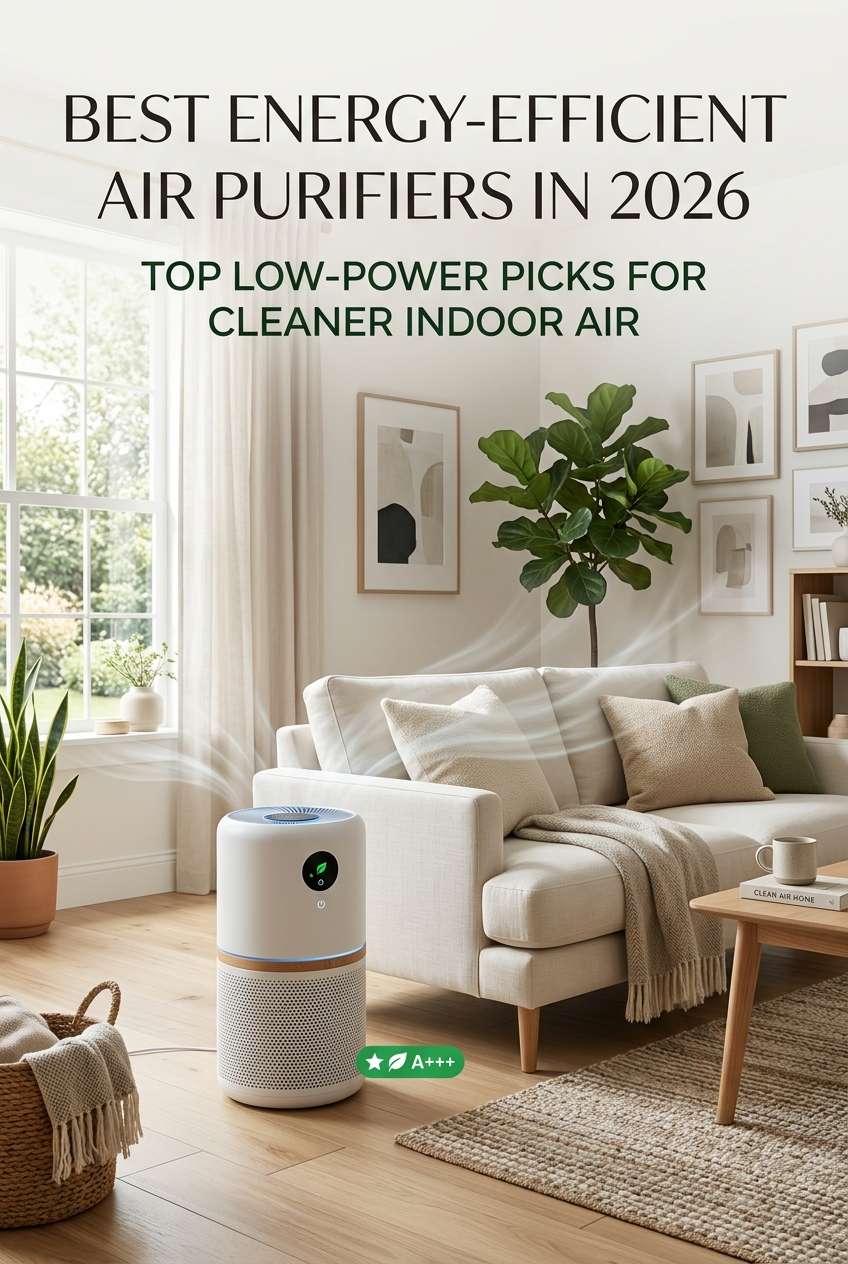
An air purifier can help reduce dust, smoke, pet dander, pollen, and other airborne particles, but there is one practical concern many buyers overlook: electricity use.
When a purifier runs for hours every day, even a modest difference in power consumption can affect your annual energy bill. That does not mean you should automatically buy the lowest-wattage model, though. A purifier that uses very little power but cannot move enough air for your room may deliver disappointing results.
The better approach is to balance air-cleaning performance, room coverage, energy consumption, filter costs, noise, and operating modes.
In this guide, we look at some of the best energy-efficient air purifiers for 2026, explain how to compare their real-world efficiency, and cover the features that can help lower running costs without sacrificing indoor air quality.
Quick Look at the Best Energy-Efficient Air Purifiers
| Air Purifier | Best For | Why Consider It |
|---|---|---|
| Levoit Core 300S | Small bedrooms and offices | Efficient, compact, smart controls |
| Levoit Core 400S | Medium rooms | Strong airflow with good efficiency |
| Coway Airmega 150 | Everyday home use | Quiet operation and balanced performance |
| PuroAir 240 | Medium-sized rooms | Simple operation and solid filtration |
| Winix 5300-2 | Larger rooms | Higher airflow and broad room coverage |
| Blueair Blue Pure 511 | Low-power operation | Compact design and low energy draw |
What Makes an Air Purifier Energy Efficient?
Energy efficiency is more complicated than the wattage printed on the box.
A purifier may use only 15 watts, but that does not automatically make it more efficient than a 25-watt model. The second unit could move significantly more filtered air in the same amount of time.
This is where CADR, or Clean Air Delivery Rate, becomes important. CADR indicates how quickly an air purifier can deliver filtered air. For an energy-conscious buyer, the most useful question is not simply “How many watts does it use?” but rather “How much clean air do I get for those watts?”
CADR and room size should come first
Start by matching the purifier to your room.
A compact purifier designed for a bedroom may be economical in a 150-square-foot space but struggle in a large open-plan living room. When a small unit has to run continuously at its highest setting, the expected energy savings may become less meaningful.
Choosing the correct size gives you more flexibility. A suitably powerful purifier can often clean the space effectively at a lower setting, especially when the room is already relatively clean.
Look beyond maximum wattage
Many air purifiers advertise maximum power consumption, but that figure does not necessarily represent what you will use every day.
A purifier may run at low speed overnight, increase airflow when its sensor detects more particles, and consume very little power while idle. Auto mode, sleep mode, timers, and scheduling can therefore have a noticeable effect on real-world energy use.
Filter efficiency matters too
The filter itself is only part of the equation. Air has to pass through the filter, and the fan motor has to move that air.
A well-designed purifier balances filtration, airflow, motor efficiency, and noise. That is why comparing the entire product rather than focusing on one specification usually produces better results.
Best Energy-Efficient Air Purifiers for 2026
Levoit Core 300S – Best Overall for Small Rooms
The Levoit Core 300S is a strong all-round choice for bedrooms, home offices, and other smaller spaces.
Its compact design makes it easy to place near a desk or bedside table, while its smart features make day-to-day operation convenient. Automatic air-quality monitoring can adjust the fan when conditions change, which is useful when you want filtration without constantly running the unit at maximum speed.
The Core 300S also offers multiple operating modes, including sleep operation, making it practical for overnight use.
Its biggest advantage is balance. It is powerful enough for a typical small room without being unnecessarily large or power-hungry.
Best for: Bedrooms, offices, apartments, and smaller rooms.
Consider another model when: Your space is significantly larger or has an open layout.
Levoit Core 400S – Best for Medium Rooms
For a larger bedroom, living room, or home office, the Levoit Core 400S is a more suitable choice.
The main reason to step up to this model is airflow. A larger purifier can clean more air per cycle, which can be important in medium-sized spaces where a smaller model may need to work much harder.
The Core 400S also combines automatic operation with smart controls, giving you more control over schedules and fan settings. That makes it easier to strike a balance between cleaning performance and electricity use.
For many households, it represents the sweet spot between a compact bedroom purifier and a much larger high-output model.
Best for: Medium bedrooms, living rooms, apartments, and larger offices.
Consider another model when: You only need filtration in a very small room and want the smallest possible footprint.
Coway Airmega 150 – Best Balanced Choice
The Coway Airmega 150 is a good option for buyers who want efficient operation without turning their air purifier into a complicated smart-home gadget.
Its compact footprint works well in bedrooms and offices, while its filtration system is designed for everyday particulate pollution. It also features a washable pre-filter, which can catch larger debris before it reaches the main filter.
That matters because basic maintenance can help preserve airflow. When dust and hair accumulate around the pre-filter, airflow can become restricted, potentially reducing performance.
The Airmega 150 is particularly appealing if you value quiet operation, straightforward controls, and a polished design.
Best for: Bedrooms, apartments, offices, and everyday household filtration.
PuroAir 240 – Best Simple Medium-Room Option
The PuroAir 240 is worth considering when you want a relatively straightforward purifier for a medium-sized room.
It is designed for users who would rather have an appliance that does its job without requiring constant adjustment. Automatic operation and built-in controls make it easy to leave the purifier running as part of a normal daily routine.
For energy-conscious households, simplicity can actually be useful. A purifier that automatically adjusts its performance can avoid running unnecessarily hard when the air is already relatively clean.
Best for: Medium bedrooms, smaller living rooms, and apartments.
Winix 5300-2 – Best for Larger Rooms
The Winix 5300-2 is a better fit for buyers who need more airflow.
Larger rooms often require a stronger purifier because there is simply more air to process. A low-power compact unit may sound attractive on paper but may not provide enough clean-air delivery for the space.
The Winix 5300-2 offers a higher-output approach and is suitable for larger bedrooms, living areas, and other rooms where stronger circulation is useful.
Its larger size also means it is not the most logical choice for a tiny bedroom. Using a powerful model in a small room can be unnecessary unless you specifically want faster air cleaning.
Best for: Larger bedrooms, living rooms, and more spacious areas.
Blueair Blue Pure 511 – Best Low-Power Compact Pick
The Blueair Blue Pure 511 is particularly interesting for people who place a high priority on low power consumption.
Its compact size and low listed energy draw make it well suited to smaller rooms where you do not need a high-capacity purifier.
The trade-off is straightforward: it is not intended to replace a larger high-CADR purifier in a big living area. Its strength is efficient operation in a suitably sized room.
Best for: Small bedrooms, offices, and users who prioritize low power consumption.
How Much Electricity Does an Air Purifier Use?
One of the easiest ways to estimate energy consumption is to convert watts into kilowatt-hours.
The basic calculation is:
Watts ÷ 1,000 × hours of operation = energy consumed
For example, a 20-watt purifier operating continuously for one year would use roughly 175 kWh.
A 40-watt purifier running under the same conditions would use about 350 kWh.
However, these are theoretical maximum-style calculations. Real usage is often lower because most purifiers do not operate at maximum power every minute of every day.
A unit running on sleep mode for eight hours overnight will use considerably less energy than the same purifier operating continuously at maximum fan speed.
How to Lower Your Air Purifier’s Energy Use
Choosing an efficient purifier is only the beginning. How you operate it also matters.
Use the right purifier for the room
This is one of the most important steps.
An undersized purifier may need to run at full speed for long periods. A correctly sized model has a better chance of maintaining clean air at a moderate setting.
The goal is not to buy the smallest appliance. It is to buy enough capacity for the room without going dramatically beyond what you need.
Use sleep mode at night
Sleep mode is useful in bedrooms because air-cleaning demand is often lower after the room has already been filtered.
The slower fan also tends to produce less noise and use less electricity.
Let auto mode do the work
Auto mode can be useful when the purifier includes an air-quality sensor.
Instead of manually selecting a high fan speed and leaving it there, the machine can respond to changes in the room. Cooking, dust, open windows, or increased activity may cause it to increase airflow, while cleaner conditions can allow it to slow down.
This can reduce unnecessary high-speed operation.
Keep the pre-filter clean
A dirty pre-filter can interfere with airflow.
Cleaning the pre-filter according to the manufacturer’s instructions helps the fan move air efficiently and keeps larger particles from building up inside the purifier.
This is especially important in homes with pets, because fur and hair can accumulate quickly.
Replace the main filter when needed
A heavily used filter eventually becomes loaded with particles.
When that happens, airflow can fall and the purifier may not work as effectively as it should. Replacing the filter at the recommended interval helps restore normal performance.
Waiting indefinitely to replace a clogged filter is usually a false economy.
Energy Efficiency vs. Cleaning Performance
It is easy to get caught up in wattage when shopping for an energy-efficient purifier, but cleaning performance should not be sacrificed.
Imagine choosing between a 15-watt purifier and a 30-watt purifier. The first sounds better from an energy perspective, but if it is designed for a small room and you put it in a much larger space, it may struggle to keep up.
The larger purifier could provide significantly more clean air and may therefore be the better choice for the actual room.
This is why performance per watt is a more useful way to think about efficiency than wattage alone.
What About Filter Replacement Costs?
Electricity is only one part of the total cost of ownership.
Replacement filters can become a significant expense over several years, particularly when a purifier runs continuously.
Before buying, check how often replacement filters are expected to be changed and how much genuine replacement filters cost. Also check availability. A cheap purifier is not much of a bargain if replacement filters are difficult to find.
Washable or vacuum-cleanable pre-filters can be especially useful because they can help extend the useful life of the primary filter.
Troubleshooting Common Air Purifier Problems
Even an efficient purifier can perform poorly if something is wrong with the setup.
The purifier seems to have weak airflow
First, inspect the filter and air intake for dust buildup.
A clogged filter restricts the amount of air that can pass through the machine, which can make the fan sound louder while producing less useful airflow. Cleaning the pre-filter or replacing the primary filter can restore normal circulation.
Also check that furniture, curtains, or walls are not blocking the intake or exhaust.
The air purifier keeps running at high speed
Check the room conditions and the purifier’s air-quality sensor.
Cooking fumes, candles, smoke, heavy dust, or an open window can cause the sensor to detect elevated particle levels. In some cases, a dusty sensor may also report poor air quality incorrectly.
Move the purifier to a more open position, reduce obvious pollution sources, and clean the sensor if the manufacturer provides instructions for doing so.
The purifier is still noisy at night
Make sure sleep mode is actually enabled.
If it is already active, inspect the filter. A loaded filter can force the fan to work harder and may create more noise.
Placement also matters. Putting a purifier directly against a wall or inside a tight corner can interfere with airflow and increase perceived noise.
The electricity bill seems higher than expected
Check how the purifier is being used rather than assuming the rated wattage is wrong.
A unit running continuously at maximum speed consumes much more energy than one operating mainly in sleep or automatic mode. Scheduling the purifier around periods of higher activity can sometimes reduce unnecessary runtime.
Should You Upgrade to a More Energy-Efficient Air Purifier?
Replacing an existing purifier is not automatically worthwhile.
If your current unit is appropriately sized, performs well, and has reasonable operating costs, there may be little benefit in replacing it simply to get a newer model.
An upgrade makes more sense when the existing purifier is noisy, inefficient, difficult to maintain, expensive to filter, underpowered for your room, or lacking useful automatic controls.
A newer model can also be worth considering when you are moving to a larger room and your current purifier has insufficient airflow.
In other words, upgrade because the new purifier solves a real problem—not simply because it has a newer name or design.
Which Energy-Efficient Air Purifier Should You Buy?
The Levoit Core 300S is one of the easiest recommendations for a small room because it combines compact size, smart controls, and solid everyday performance.
For medium spaces, the Levoit Core 400S offers a useful step up in airflow without moving into an unnecessarily large appliance.
The Coway Airmega 150 is a strong choice for buyers who prefer balanced performance and simple operation, while the PuroAir 240 is worth considering for straightforward medium-room filtration.
For larger rooms, the Winix 5300-2 makes more sense because its higher airflow is better suited to larger spaces. Meanwhile, the Blueair Blue Pure 511 is a compelling option for small rooms where minimizing electricity consumption is especially important.
Final Verdict
The best energy-efficient air purifier in 2026 is not necessarily the model with the lowest power rating. The smartest choice is the one that provides enough clean-air delivery for your room without using more energy than necessary.
For small rooms, the Levoit Core 300S and Blueair Blue Pure 511 are excellent places to start. The Coway Airmega 150 offers a balanced alternative, while the Levoit Core 400S is a stronger fit for medium-sized spaces. Larger rooms may benefit from the additional airflow of the Winix 5300-2.
Before buying, focus on the combination of CADR, room size, power consumption, filter costs, noise, and automatic operating modes. Then maintain the purifier properly and avoid blocking its airflow.
A well-matched purifier that runs efficiently can keep your indoor air cleaner while helping prevent unnecessary energy use—a much better result than simply choosing the appliance with the smallest number of watts.