
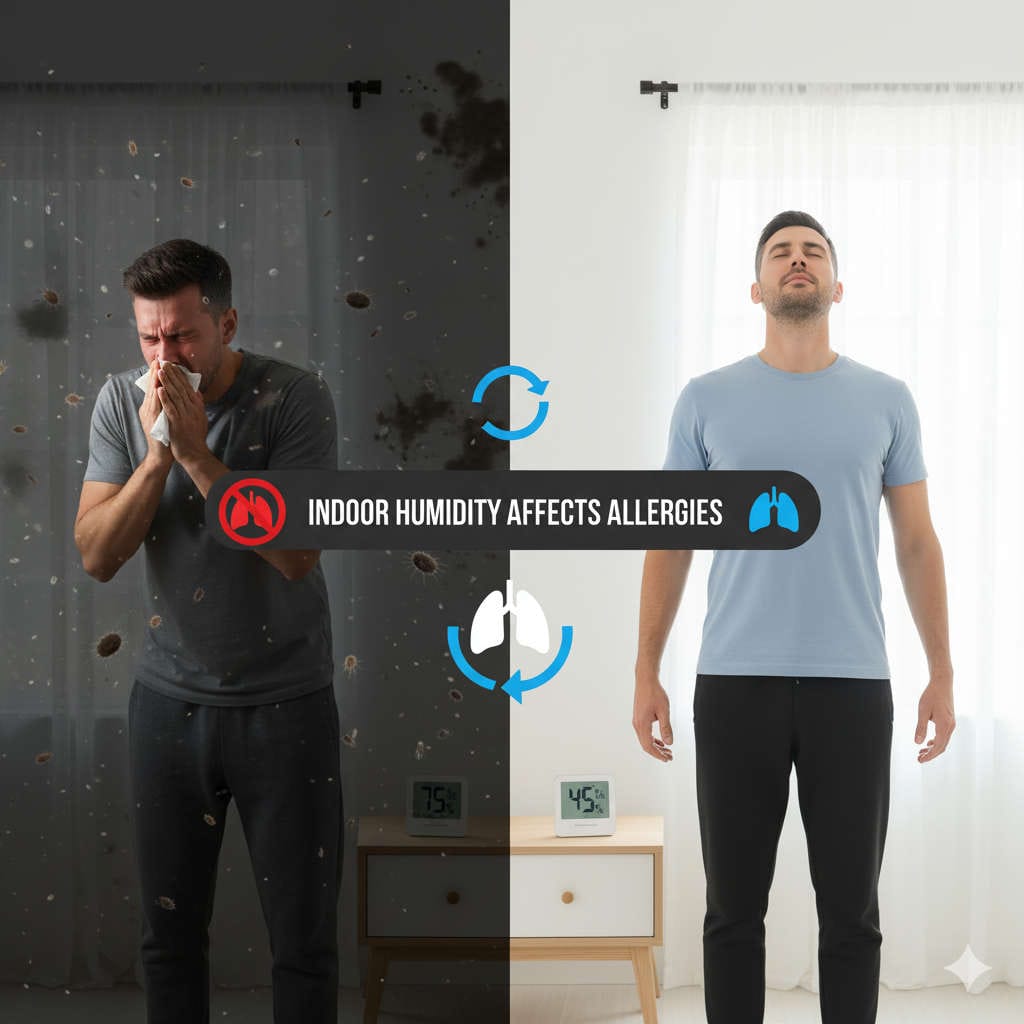
Have you ever wondered why your allergies seem worse some days, even when you’re safely indoors? Or why your home feels stuffy in summer and uncomfortably dry in winter, no matter what you do with the thermostat? The answer might surprise you—it’s all about the moisture hanging in your air.
I’ve spent years helping homeowners understand their indoor environments, and humidity is hands-down one of the most overlooked factors affecting daily comfort and health. Let me share what I’ve learned about this invisible force that shapes how you feel in your own home.
What Exactly Is Indoor Humidity? (And Why Should You Care?)
Think of humidity as invisible moisture particles floating through every room in your house. Scientists measure it as “relative humidity”—basically, how much moisture your air contains compared to how much it could possibly hold at the current temperature.
Here’s what really matters: Your home’s humidity level should hover somewhere between 30% and 50% for optimal health and comfort. Stray too far in either direction, and you’re setting yourself up for problems ranging from mild discomfort to serious allergy flare-ups.
The tricky part? Most people have no idea what their indoor humidity actually measures. They just know something feels “off” without understanding the root cause.
The High Humidity Problem: When Your Home Becomes an Allergen Factory
Let me paint you a picture of what happens when humidity creeps above 50% in your living spaces.
Your Invisible Roommates: Dust Mites
Dust mites are microscopic creatures—we’re talking smaller than a pinhead—that absolutely love humid conditions. These little critters feast on the dead skin cells you naturally shed every day (yes, it’s gross, but completely normal).
When your home’s humidity rises above 50%, dust mites throw a party. They reproduce rapidly, settling into your mattress, pillows, couches, and carpets. The real problem isn’t the mites themselves—it’s their waste products. These particles become airborne and trigger classic allergy symptoms: relentless sneezing, watery eyes, congestion, and for asthma sufferers, potentially serious breathing difficulties.
I’ve seen families struggle with “mysterious” worsening allergies, only to discover their bedroom humidity was sitting at 65%. Once they brought it down to 45%, their symptoms improved dramatically within weeks.
The Mold Menace: Silent but Serious
Here’s something that keeps me up at night: mold can start growing in just 24-48 hours when humidity exceeds 60%. It doesn’t need a major flood or obvious water leak—persistent high humidity alone provides everything mold needs to colonize your walls, ceilings, and hidden spaces.
Mold releases spores continuously, and these spores are potent allergens. Some people experience mild symptoms like sniffling and sneezing. Others develop severe reactions including chronic coughing, wheezing, skin rashes, and persistent fatigue. Certain mold varieties produce mycotoxins that can cause even more serious health issues.
The bathroom mirror that won’t clear after your shower? Condensation on your windows? That musty smell in your basement? These are all red flags screaming “humidity problem!”
The Sticky, Miserable Feeling
Beyond allergens, excess humidity makes your home feel like a sauna. When humidity is high, your sweat can’t evaporate efficiently—that’s your body’s primary cooling system. Result? You feel hot, sticky, and uncomfortable even when your thermostat shows a reasonable temperature.
This is why 78°F with 70% humidity feels absolutely miserable, while 78°F with 40% humidity feels perfectly pleasant.
Chemical Releases You Can’t See
Here’s something many people don’t realize: high humidity actually increases off-gassing from furniture, carpets, paint, and building materials. These volatile organic compounds (VOCs) are released faster in humid conditions, potentially irritating your airways and amplifying allergy-like symptoms.
The Low Humidity Crisis: When Desert Conditions Come Indoors
Now let’s flip the script and talk about what happens when humidity drops below 30%—a common winter problem in heated homes.
Your Body’s Defense System Breaks Down
Your nose and throat are lined with mucous membranes that act as your personal air filtration system. These moist tissues trap allergens, dust, bacteria, and viruses before they can penetrate deeper into your respiratory system.
When indoor air becomes desert-dry, these protective membranes dry out and crack. Suddenly, your body’s first line of defense is compromised. Allergens pass through more easily. You become more susceptible to infections. Some people develop painful nosebleeds or a persistent scratchy throat.
I always tell people: if you’re waking up with a dry, sore throat every morning during winter, low humidity is probably the culprit.
Allergens Stay Suspended Longer
In adequately humid air, moisture naturally weighs down airborne particles, causing them to settle onto surfaces where they can be cleaned away. In very dry air, pollen, pet dander, and dust particles remain floating and suspended for extended periods.
Translation? You’re breathing in significantly more allergens with every breath when your air is too dry.
Your Skin and Eyes Rebel
Ever noticed how your skin gets itchy and flaky in winter? How your eyes feel gritty and irritated? Low humidity sucks moisture directly from your body’s surfaces.
For people with eczema, psoriasis, or other skin conditions, low humidity can trigger severe flare-ups. Contact lens wearers often find their lenses unbearably uncomfortable. Even healthy skin develops that tight, uncomfortable feeling and may crack at knuckles and elbows.
The Shocking Evidence
Those annoying static electricity zaps when you touch doorknobs or shake hands? That’s your home telling you the air is way too dry. While not directly harmful, it’s a reliable indicator that your humidity has dropped too low.
Why Humidity Swings With the Seasons (And What to Do About It)
Summer Humidity Headaches
Summer typically brings muggy outdoor conditions, especially in coastal areas, the Southeast, and Midwest regions. Your air conditioner works to cool your home, and fortunately, AC systems naturally remove some moisture as they operate.
However, if your AC unit is oversized for your space, it might cool rooms too quickly without running long enough to adequately dehumidify. Similarly, an aging or poorly maintained system might struggle with moisture removal even while cooling effectively.
Basements present special challenges. Cool underground spaces combined with summer’s humid air create perfect conditions for condensation and moisture problems.
Summer action steps:
- Ensure your AC system is appropriately sized and well-maintained
- Use standalone dehumidifiers in problematic areas like basements
- Run bathroom exhaust fans during and after showers
- Consider a whole-house dehumidifier if humidity remains consistently high
Winter Dryness Dilemmas
Cold air inherently holds less moisture than warm air—it’s simple physics. When your heating system warms up this naturally dry outdoor air, the relative humidity plummets even further. This is why winter air feels so parched, particularly in climates with freezing temperatures.
Forced-air heating systems are particularly notorious for creating dry indoor conditions. Every cycle of heating further reduces relative humidity, sometimes dropping levels below 20% in poorly managed homes.
Winter action steps:
- Invest in a quality humidifier (more on choosing one below)
- Let shower steam disperse into your home rather than immediately venting it all outside
- Place houseplants strategically—they release moisture naturally
- Consider a whole-home humidification system integrated with your heating
- Leave bathroom doors open after bathing to spread moisture
Your Complete Action Plan for Perfect Humidity Levels
Step 1: Know Your Numbers
You can’t manage what you don’t measure. A hygrometer (humidity measuring device) is inexpensive—usually $10-30—and absolutely essential. Digital models provide the most accurate readings and often include temperature as well.
Place hygrometers in several locations: your main living area, bedrooms, and any problem spots like basements or bathrooms. Check them regularly, noting patterns throughout the day and across seasons.
Target zone: 30-50% relative humidity, with 40-45% being ideal for most people.
Step 2: Tackle High Humidity Problems
Invest in the right dehumidifier: For spaces up to 1,500 square feet, a portable dehumidifier works well. Larger homes or those with persistent humidity issues might need a whole-house dehumidifier installed in your HVAC system. Look for Energy Star certified models to minimize electricity costs.
Maximize ventilation: Use exhaust fans religiously in bathrooms and kitchens—these rooms generate enormous amounts of moisture from showers, baths, and cooking. Run fans for at least 15-20 minutes after activity ends.
Seal and repair: Fix any leaks immediately. Check your roof, windows, foundation, and plumbing regularly. Even small leaks contribute to humidity problems and can cause major damage over time.
Strategic air conditioning use: Your AC is a powerful dehumidifier. On humid days, running your AC even when temperatures are moderate can help control moisture levels.
Reduce moisture generation: Take shorter, cooler showers. Always vent your clothes dryer outdoors (never into your home). Avoid drying laundry indoors. Use lids when cooking to contain steam.
Improve air circulation: Ceiling fans and portable fans help prevent stagnant, humid pockets from forming. Good airflow is your friend.
Step 3: Combat Low Humidity Effectively
Choose the right humidifier: Several types exist, each with advantages:
- Cool mist humidifiers: Safe around children, energy-efficient, good for smaller spaces
- Warm mist humidifiers: Can kill more bacteria, make rooms feel warmer, but use more energy
- Ultrasonic humidifiers: Quiet operation, efficient, but require distilled water to avoid white dust
- Whole-house humidifiers: Integrated into HVAC, humidify entire home, most convenient but require professional installation.
Size your humidifier appropriately for your space. Undersized units won’t adequately humidify; oversized ones might create localized wet spots.
Critical maintenance note: Clean humidifiers thoroughly every 3-4 days and change filters according to manufacturer recommendations. Dirty humidifiers can become breeding grounds for bacteria and mold, completely defeating your health goals.
Natural moisture boosters: While not substitutes for mechanical humidifiers, these small steps help:
- Keep 5-7 houseplants in your main living areas
- Place water bowls near heating vents or radiators
- Leave bathroom doors ajar after showering
- Air-dry some laundry indoors (just don’t overdo it)
Step 4: Monitor and Adjust Continuously
Humidity needs change with weather, seasons, and activities. Check your hygrometers weekly and adjust your humidifiers or dehumidifiers accordingly. Think of humidity management as ongoing maintenance, not a one-time fix.
Beyond Humidity: Your Complete Allergy Defense Strategy
While optimizing humidity provides enormous benefits, combine it with these additional strategies for maximum allergy relief:
Upgrade your air filtration: Replace standard HVAC filters with high-efficiency MERV 11-13 filters. These capture significantly more allergen particles. Change filters every 2-3 months (monthly during high-use seasons).
Consider HEPA air purifiers: Place high-quality HEPA purifiers in bedrooms and main living areas. These remove 99.97% of particles 0.3 microns or larger—including pollen, pet dander, dust mites, and mold spores.
Establish a cleaning routine: Vacuum at least twice weekly using a vacuum with HEPA filtration. Dust with damp cloths (dry dusting just redistributes allergens). Wash bedding weekly in water hotter than 130°F to kill dust mites.
Minimize allergen havens: Consider replacing wall-to-wall carpeting with hard flooring. Reduce upholstered furniture. Use washable curtains rather than heavy drapes. Every surface you can easily clean is one less place for allergens to accumulate.
Protect your sleeping environment: Encase mattresses and pillows in allergen-proof covers. These barrier covers prevent dust mites from accessing their favorite habitat—your bedding.
Manage indoor plants carefully: While plants add humidity and clean air, they can harbor mold in their soil. If mold is your primary concern, limit the number of plants or use pebble trays rather than keeping soil constantly moist.
Professional HVAC maintenance: Schedule annual inspections and cleanings. Technicians can identify mold in ductwork, ensure proper system function, and optimize your HVAC for both temperature and humidity control.
Create an entryway routine: Remove shoes at the door to avoid tracking outdoor allergens inside. Consider keeping a mat outside and inside your entrance.
Real-World Success Stories: How Humidity Changes Lives
Sarah’s story: Sarah had suffered from morning congestion and headaches for years. Doctors found no obvious cause. When she finally checked her bedroom humidity, it measured just 23% during winter. After installing a quality humidifier and maintaining 40-45% humidity, her symptoms resolved within three weeks.
The Martinez family: The Martinez family couldn’t figure out why their daughter’s asthma kept worsening despite medication. A home inspection revealed 68% humidity in their basement playroom and visible mold behind furniture. After professional mold remediation, installing a basement dehumidifier, and maintaining proper humidity levels, their daughter’s asthma attacks decreased by 80%.
Tom’s experience: Tom thought his “seasonal allergies” were just something he had to live with. When he discovered his entire house ran at 58% humidity year-round, he took action. A whole-house dehumidifier brought levels to 42%, and within a month, his daily allergy symptoms improved so dramatically that he reduced his medication (with his doctor’s approval).
These aren’t isolated cases. I’ve witnessed countless similar transformations when people finally address their humidity issues.
Common Questions About Humidity and Allergies
Q: Can humidity affect my sleep quality? Absolutely. Both excessive and insufficient humidity disrupt sleep. High humidity makes you feel hot and sweaty, interrupting rest. Low humidity dries out your throat and nasal passages, causing you to wake with discomfort or snoring. The 40-45% sweet spot promotes deeper, more restful sleep.
Q: How quickly will I notice improvement after fixing humidity problems? Some people feel relief within days, particularly regarding dry skin and respiratory comfort. Allergy improvements typically take 2-4 weeks as allergen populations (like dust mites) decline and your mucous membranes heal.
Q: Is there a “best” humidity level, or does it vary by person? The 30-50% range works for most people, but some individual variation exists. Experiment within this range to find your personal comfort zone. Many people find 42-45% ideal.
Q: Will fixing humidity eliminate my allergies completely? Probably not entirely, but proper humidity management often reduces symptoms by 50-70% or more. Combined with other environmental controls, many people experience life-changing improvement.
Q: Are smart humidifiers and dehumidifiers worth the extra cost? If you struggle to remember manual adjustments, yes. Smart devices automatically maintain target humidity levels and can be controlled remotely. The convenience ensures consistent humidity management, which delivers better results.
Take Action Today: Your First Steps
Feeling overwhelmed? Start simple:
- This week: Purchase a hygrometer and measure your home’s humidity in multiple locations
- Next week: Based on your readings, buy an appropriately sized humidifier or dehumidifier
- This month: Establish a monitoring routine and fine-tune your humidity levels
- Ongoing: Maintain your equipment, monitor readings weekly, and adjust seasonally
You don’t need to tackle everything at once. Each small step toward optimal humidity improves your comfort and health.
The Bottom Line: Humidity Is Your Hidden Health Lever
After helping hundreds of families improve their indoor environments, I can tell you with certainty: humidity management is one of the highest-impact, lowest-effort changes you can make for allergy relief and home comfort.
That invisible moisture in your air—too much or too little—shapes your daily experience more than you probably realize. Excessive humidity invites dust mites, mold, and that miserable sticky feeling. Insufficient humidity dries out your protective membranes, keeps allergens airborne, and makes your skin and eyes uncomfortable.
The beautiful thing? Unlike many health challenges, this one has straightforward, affordable solutions. A simple hygrometer shows you where you stand. The right humidifier or dehumidifier brings levels into the optimal range. Regular monitoring keeps things on track.
Your home should be your sanctuary—a place where you breathe easily, feel comfortable, and get relief from outdoor allergens. Proper humidity control transforms that vision into reality.
So here’s my challenge to you: measure your humidity this week. You might be surprised by what you discover. And those numbers might just explain symptoms you’ve been struggling with for months or even years.
Your nose, throat, lungs, skin, and overall comfort are waiting for you to take this simple step. Why not start today?
Have you discovered humidity issues in your home? What changes made the biggest difference for your allergies and comfort? Share your experience in the comments below—your insights might help others dealing with similar challenges.
Related Resources:
- American Academy of Allergy, Asthma & Immunology
- Environmental Protection Agency – Indoor Air Quality
- Asthma and Allergy Foundation of America
Disclaimer: This article provides general information about indoor humidity and allergies. It is not intended as medical advice. Always consult with qualified healthcare professionals for diagnosis and treatment of allergies or other health conditions.
You might also like,
- HEPA vs Electrostatic Filters: Which Air Filter Is Best for Allergies?
- 10 Easy Ways to Reduce Allergies at Home | Allergy-Friendly Living
- Best Electrostatic Pleated AC Filters for Allergies & Dust (2025 Guide)
- How Often Should You Change Your AC Filter? Complete Homeowner’s Guide
- Best HEPA Air Purifiers for Bedrooms (2025): Sleep Better & Breathe Cleaner Air