
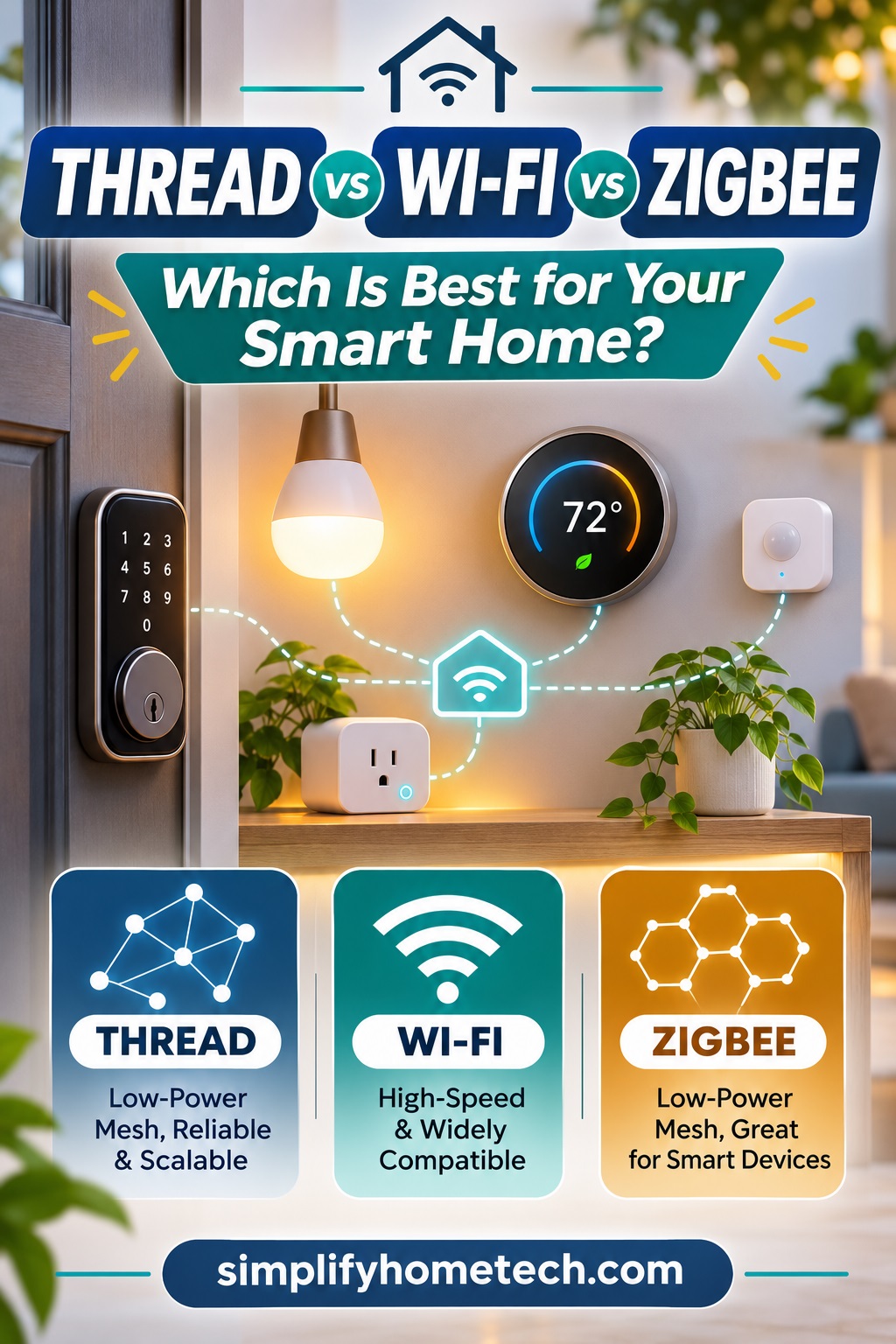
Choosing the right wireless technology can make your smart home faster, more reliable, and easier to manage. Whether you’re installing smart bulbs, motion sensors, security cameras, or smart locks, the way these devices communicate plays a major role in their everyday performance.
Three technologies frequently appear in smart home discussions: Thread, Wi-Fi, and Zigbee. Although they all connect smart devices, each takes a different approach to speed, energy efficiency, coverage, and compatibility.
Wi-Fi is familiar and widely supported. Zigbee has a long history in smart lighting and home automation. Thread is a newer option that has gained attention through its close relationship with Matter, the smart home interoperability standard.
But is Thread better than Zigbee? Should you stick with Wi-Fi? And does Matter change which technology you should choose?
This guide compares Thread vs. Wi-Fi vs. Zigbee, explains their strengths and limitations, and helps you decide which connection makes the most sense for your smart home in 2026.
Understanding Thread, Wi-Fi, and Zigbee
Before comparing performance, it helps to understand how these wireless technologies work. While all three allow devices to exchange information, they use different networking methods.
What Is Thread?
Thread is a low-power wireless networking technology built for smart home devices that exchange small amounts of data.
It uses mesh networking, which means compatible devices can pass information through one another instead of relying on a single direct connection.
For example, a Thread-enabled smart lock might communicate through a nearby Thread router device to reach the rest of your smart home network.
If one routing device becomes unavailable, the network can often find another path.
Thread also uses Internet Protocol (IP), making it well suited to modern smart home systems.
A typical Thread setup includes battery-powered end devices, mains-powered routing devices, and a Thread Border Router that connects the Thread network to Wi-Fi or Ethernet.
Thread is particularly useful for smart locks, contact sensors, motion detectors, and other devices that need reliable communication without consuming much power.
What Is Wi-Fi?
Wi-Fi is the wireless technology most households already use for internet connectivity.
Smartphones, laptops, smart TVs, security cameras, and many smart appliances connect through a Wi-Fi router or wireless access point.
One of Wi-Fi’s biggest advantages is convenience. Many Wi-Fi smart devices can connect directly to your existing network without requiring a dedicated smart home hub.
Wi-Fi also provides far more bandwidth than Thread or Zigbee, making it ideal for devices that stream video, transmit audio, or exchange large amounts of data.
However, conventional Wi-Fi connections often consume more power, making them less attractive for small battery-operated sensors.
What Is Zigbee?
Zigbee is a low-power wireless technology designed for automation and connected devices.
Like Thread, it supports mesh networking. Compatible mains-powered Zigbee devices can relay messages, helping extend coverage across a home.
Zigbee is commonly used in smart lighting, switches, plugs, temperature sensors, and motion detectors.
Most Zigbee systems require a compatible hub or coordinator to manage communication between devices.
Although Zigbee has existed for many years, it remains relevant because of its mature ecosystem, energy efficiency, and reliable local automation capabilities.
Thread vs. Wi-Fi vs. Zigbee: Quick Comparison
The following table highlights the main differences between these three smart home communication technologies.
| Feature | Thread | Wi-Fi | Zigbee |
|---|---|---|---|
| Network design | Low-power mesh | Access-point-based | Low-power mesh |
| Common frequency | 2.4 GHz | 2.4, 5, and sometimes 6 GHz | Usually 2.4 GHz |
| Power consumption | Very low | Generally higher | Very low |
| Data bandwidth | Low | High | Low |
| Additional equipment | Border Router for wider network access | Existing Wi-Fi router | Usually a Zigbee hub |
| Battery-powered devices | Excellent | Less suitable in many cases | Excellent |
| Mesh networking | Built in | Supported by mesh Wi-Fi systems | Built in |
| Matter support | Native with Matter-over-Thread | Native with Matter-over-Wi-Fi | Usually through a compatible bridge |
| Best applications | Locks, sensors, switches | Cameras, displays, appliances | Lighting, sensors, automation |
The key difference is straightforward: Wi-Fi focuses on higher-bandwidth connectivity, while Thread and Zigbee prioritize efficient communication between low-power devices.
Thread vs. Wi-Fi vs. Zigbee: Which Performs Better?
Technical specifications only tell part of the story. What matters most is how each technology behaves when you’re actually using your smart home.
Speed and Response Time
Wi-Fi easily leads in raw data transfer speed.
It can handle high-definition video, audio streaming, and substantial software downloads. Thread and Zigbee cannot compete with that level of bandwidth.
However, faster data transfer does not always mean faster smart home automation.
A motion sensor only needs to send a small command to turn on a light. Thread and Zigbee can handle that task efficiently, often with very little delay.
Actual response times depend on signal quality, device firmware, routing, and whether commands are processed locally or through an internet service.
Best choice: Wi-Fi for demanding data transfers; Thread or Zigbee for lightweight automation.
Battery Life and Energy Efficiency
Battery performance is one of the strongest reasons to consider Thread or Zigbee.
Both technologies allow many battery-powered devices to sleep between communications, reducing unnecessary energy use.
A contact sensor, for instance, may only need to report when a door opens or closes.
With an efficient wireless design, some sensors can operate for years before needing a replacement battery.
Wi-Fi devices typically require more energy to maintain connectivity, although power-saving features and battery life vary significantly between products.
Best choice: Thread or Zigbee for battery-powered sensors, buttons, and smart locks.
Range and Mesh Network Coverage
Wireless range becomes particularly important in larger homes.
A traditional Wi-Fi device connects to an access point. If that signal is weak, performance can suffer.
Mesh Wi-Fi systems solve some coverage problems by distributing multiple access points throughout the property.
Thread and Zigbee work differently. Their networks can forward messages through compatible routing devices.
For example, a sensor in an upstairs bedroom may communicate through a smart plug located in the hallway rather than connecting directly to the network’s central equipment.
This can improve coverage, especially when devices are spread across several rooms.
However, battery-powered sensors generally do not extend the mesh. You need compatible mains-powered routing devices positioned where they can maintain reliable connections.
Best choice: Thread and Zigbee for distributed, low-power networks; Wi-Fi with suitable access points for high-bandwidth coverage.
Reliability and Local Control
A dependable smart home should not stop working every time your internet connection drops.
Thread and Zigbee can support local communication between compatible devices without relying on cloud services.
Wi-Fi devices can also work locally, but their behavior depends on the manufacturer and software design.
Some Wi-Fi smart plugs continue responding through a local controller during an internet outage. Others rely on cloud servers and may lose important functions.
Mesh networking also helps Thread and Zigbee maintain communication when alternative routing paths are available.
Nevertheless, no protocol guarantees perfect reliability.
A poorly positioned Thread router can cause as many problems as a weak Wi-Fi signal.
Best choice: Prioritize local-control support, strong wireless coverage, and reliable hardware rather than choosing a protocol based on its name alone.
Thread vs. Zigbee: Which Is Better for Smart Home Automation?
Thread and Zigbee are often compared directly because both support low-power mesh networking.
Their main difference lies in how they communicate with other systems.
Thread uses IP-based networking. This makes it a natural foundation for Matter-compatible smart home devices.
Zigbee uses its own networking system and generally communicates with broader smart home platforms through a compatible hub or bridge.
For new installations focused on Matter, Thread is an appealing choice.
However, Zigbee remains highly practical for smart lighting and established automation systems.
If you already own a Zigbee hub and several compatible devices, replacing everything with Thread would rarely provide enough benefit to justify the cost.
Thread may be a better starting point for someone building a new Matter-focused system, while Zigbee can offer excellent value when expanding an existing setup.
How Matter Affects Thread, Wi-Fi, and Zigbee
Matter is an important development in smart home technology, but it is often misunderstood.
Matter is not another wireless protocol competing directly with Thread, Wi-Fi, or Zigbee.
Instead, it is an interoperability standard designed to help compatible smart devices work across participating platforms.
Matter devices can communicate over Thread, Wi-Fi, or Ethernet. Bluetooth Low Energy is also commonly involved during initial setup.
If you’re planning to use Matter-over-Thread devices, understanding how a Thread Border Router works can help you choose compatible hardware and avoid common setup problems.
Matter Over Thread
Matter-over-Thread combines Matter’s interoperability features with Thread’s low-power mesh network.
This makes it suitable for sensors, smart locks, and other accessories that exchange small amounts of information.
A Matter-over-Thread setup requires a compatible Matter controller and Thread Border Router. Some smart home products provide both functions.
Matter Over Wi-Fi
Matter-over-Wi-Fi devices use your existing wireless network while supporting the Matter standard.
Smart plugs, appliances, and certain lighting products can use this approach.
A Matter controller is still required, but a Thread Border Router is unnecessary for a Wi-Fi-only Matter device.
Can Zigbee Devices Work With Matter?
Yes, some Zigbee devices can connect to Matter ecosystems through compatible bridges.
For example, a supported lighting bridge may expose connected Zigbee bulbs to a Matter controller.
However, this does not convert the bulbs into native Thread devices.
Also, not every product feature is guaranteed to work through Matter. Compatibility depends on the bridge, firmware, and supported device functions.
Which Smart Home Devices Should Use Thread, Wi-Fi, or Zigbee?
Instead of choosing one protocol for your entire house, consider the requirements of each device.
| Smart home device | Recommended technology |
|---|---|
| Security cameras | Wi-Fi or Ethernet |
| Video doorbells | Wi-Fi or Ethernet |
| Battery-powered motion sensors | Thread or Zigbee |
| Smart door locks | Thread or Zigbee |
| Smart bulbs | Zigbee, Thread, or Wi-Fi |
| Smart plugs | Any of the three |
| Temperature sensors | Thread or Zigbee |
| Smart speakers | Wi-Fi or Ethernet |
| Smart blinds | Thread or Zigbee |
| Connected appliances | Usually Wi-Fi |
These recommendations are not strict rules.
A well-designed Wi-Fi smart lock may perform better than a poorly implemented Thread model. Similarly, Wi-Fi lighting can work perfectly well in smaller installations.
Device quality, supported features, and ecosystem compatibility matter as much as the connection technology.
Pros and Cons of Thread, Wi-Fi, and Zigbee
Each protocol involves trade-offs. Understanding them helps prevent unnecessary purchases and compatibility problems.
Thread: Advantages and Limitations
Thread offers low power consumption, mesh networking, IP-based communication, and strong compatibility with Matter-focused systems.
Its main limitations include the need for suitable Border Router infrastructure, varying device availability, and occasional setup complications.
It is not intended for high-bandwidth applications such as video streaming.
Wi-Fi: Advantages and Limitations
Wi-Fi is widely available, provides excellent bandwidth, and usually works with existing home networking equipment.
It is convenient for beginners and supports a broad range of smart devices.
Its disadvantages include potentially higher power consumption, wireless congestion, and reliance on cloud services in some products.
Zigbee: Advantages and Limitations
Zigbee offers efficient mesh communication, a mature device ecosystem, and dependable automation when properly configured.
It is especially useful for lighting systems and large collections of sensors.
However, it usually needs a coordinator, cross-brand compatibility can vary, and Matter integration often requires a bridge.
Common Thread, Wi-Fi, and Zigbee Connection Problems
Even good equipment can develop connectivity problems. The following checks address several common causes without requiring you to replace your devices.
Thread Device Not Connecting
First, confirm that your Thread Border Router is powered on and connected to the home network. If you’re installing a Matter-over-Thread device, also check that a compatible Matter controller is available.
Next, move the device closer to the Border Router or another Thread router during setup.
Why it works: A stable signal makes initial commissioning more reliable, while the correct network infrastructure allows the device to join and communicate.
If pairing still fails, update compatible controller software and device firmware. Remove an incomplete pairing using the manufacturer’s instructions before attempting setup again.
Wi-Fi Smart Device Keeps Disconnecting
Check whether your device supports your router’s wireless frequency and security settings. Many budget smart devices require 2.4 GHz Wi-Fi.
Move the device closer to the router to test signal strength. You can also restart the affected device and check for firmware updates.
Why it works: Better signal quality reduces lost wireless transmissions, while compatible network settings and updated software can resolve connection failures.
If disconnections happen across several devices, investigate the router rather than resetting each smart product individually.
Zigbee Sensors Respond Slowly
Start by checking the Zigbee coordinator and its connection to your automation system.
Then inspect the placement of nearby mains-powered Zigbee routing devices.
Adding a compatible router between distant sensors and the coordinator may improve communication. Also, check whether nearby 2.4 GHz Wi-Fi networks are causing interference.
Why it works: Stronger routing paths reduce failed transmissions, while lower wireless interference helps messages reach their destinations consistently.
Matter Device Works in One App but Not Another
Confirm that both smart home platforms support the device and its required Matter features.
Use the manufacturer’s supported Matter sharing process to add the device to the second ecosystem.
Also, check whether network settings are blocking local device discovery.
Why it works: Matter multi-admin control requires proper commissioning into each platform. Network restrictions can prevent controllers from discovering or communicating with devices.
How to Improve Smart Home Network Reliability
Regardless of the protocol you choose, a few practical improvements can make your entire system more dependable.
Start by positioning Wi-Fi routers and smart home hubs away from large metal objects, dense walls, and sources of electrical interference.
Avoid placing separate wireless radios directly beside one another unless the equipment is designed for that arrangement.
For larger Thread or Zigbee installations, distribute compatible mains-powered routing devices across the home.
This creates more opportunities for reliable communication paths.
If your 2.4 GHz Wi-Fi network is congested, consider moving capable devices to 5 GHz, 6 GHz, or Ethernet.
Finally, keep device firmware and controllers updated. Software improvements can resolve connection problems, improve security, and address compatibility issues.
Should You Replace Zigbee or Wi-Fi Devices With Thread?
Upgrading to Thread is not automatically necessary.
If your current Zigbee lighting system works reliably, replacing every bulb and sensor may provide little practical improvement.
Likewise, a stable Wi-Fi security camera has no reason to switch to Thread, which is unsuitable for video streaming.
Consider Thread when purchasing new battery-powered devices, expanding a Matter-focused home, or replacing older products that no longer receive support.
A replacement may also make sense when an existing device frequently disconnects, lacks important automation features, or cannot integrate with your preferred platform.
Even then, compare the complete product rather than focusing only on wireless connectivity.
Battery performance, software support, security, and reliability should influence the purchase.
Frequently Asked Questions
Is Thread Better Than Wi-Fi for a Smart Home?
Thread is often better for battery-powered sensors, locks, and low-power automation. Wi-Fi is better for cameras, smart displays, and devices that transfer large amounts of data.
Is Thread More Reliable Than Zigbee?
Both can provide reliable mesh networking. Actual performance depends on network coverage, routing devices, interference, and hardware quality. Neither is universally more reliable.
Does Thread Require a Hub?
Thread needs a Border Router for connectivity to other home networks. Matter-over-Thread devices also require a compatible Matter controller. One product may provide both functions.
Can Thread and Zigbee Work Together?
Yes, within a compatible smart home system. However, they cannot communicate directly with one another. Integration requires suitable controllers, hubs, bridges, or automation software.
Will Thread Replace Zigbee?
Thread is gaining adoption, particularly through Matter, but Zigbee remains widely used. Both technologies are likely to remain relevant for smart home automation.
Can Thread Work Without Internet?
Yes. Thread devices can exchange information over their local mesh without internet access. However, remote access and certain controller or cloud-based features may require an internet connection.
Is Zigbee Still Worth Buying in 2026?
Yes. Zigbee is still a strong option for smart lighting, sensors, switches, and established automation systems, especially when compatible infrastructure is already installed.
Which Is Best for a New Smart Home?
For many new installations, Matter-compatible Thread devices combined with Wi-Fi equipment provide a flexible foundation. Zigbee is also worth considering for lighting, sensors, and compatible hub-based systems.
Final Verdict: Which Is Best for Your Smart Home?
When comparing Thread vs. Wi-Fi vs. Zigbee, there is no single winner for every device or household.
Thread is an excellent choice for low-power accessories and people building around Matter. Wi-Fi remains essential for cameras, appliances, and other devices that require high data speeds. Zigbee continues to offer dependable automation, particularly for lighting and sensor networks.
For most households, combining these technologies provides the best balance of performance, flexibility, and energy efficiency.
If your current smart home works reliably, there is no need to replace devices simply because a newer protocol exists. Instead, focus on improving network coverage, keeping firmware updated, and checking compatibility before making additions.
When something stops responding, start with the simple fixes: verify network connections, improve signal strength, check routing devices, and update software.
By matching each device to the right wireless technology, you can build a smart home that responds quickly, runs efficiently, and remains easy to expand as your needs change.