
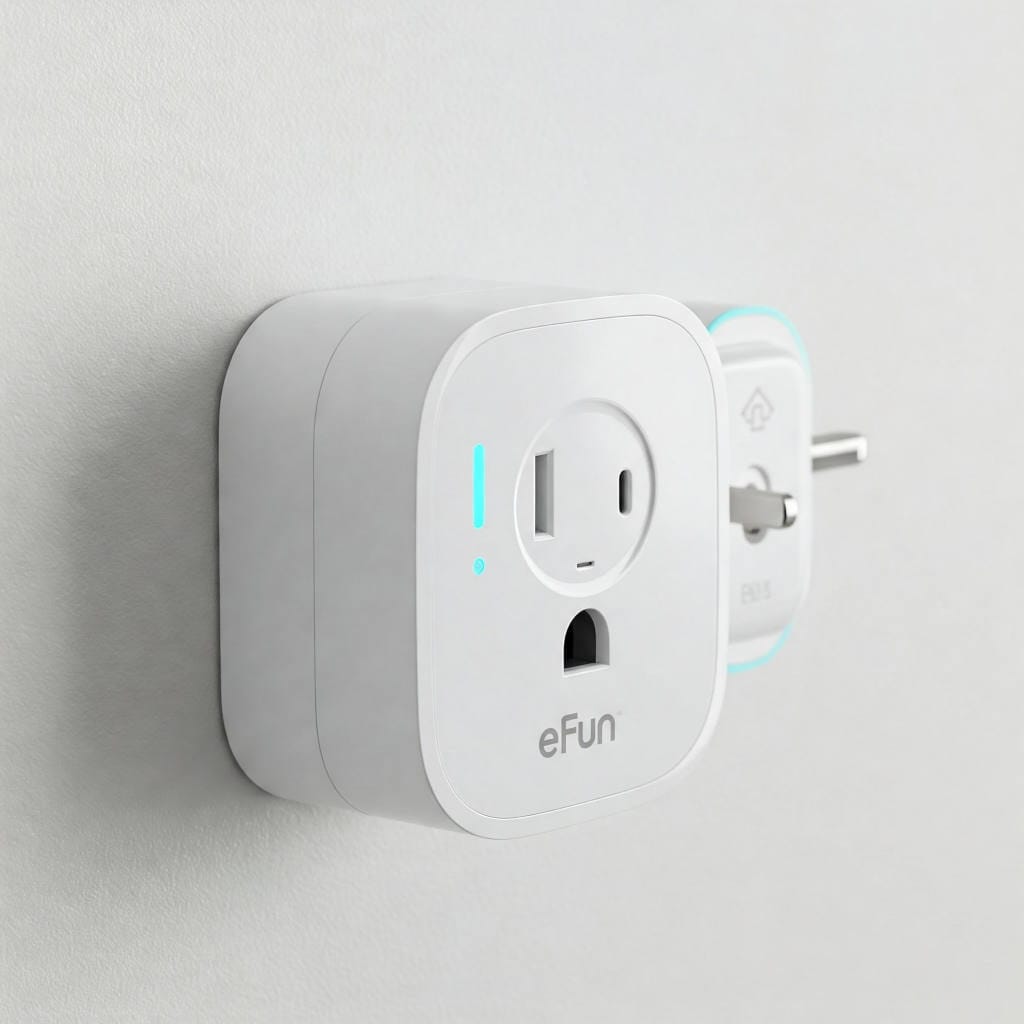
The eFun Smart Plug is an affordable way to bring smart home features to everyday electrical devices. Instead of replacing your lamps, decorative lights, or other household appliances, you can control them through your smartphone, create schedules, and even use voice commands with compatible smart assistants.
However, getting a smart plug to work isn’t always as straightforward as plugging it into a wall socket. Wi-Fi connection problems, pairing failures, and confusing app settings can make the initial setup frustrating, particularly if you’re new to home automation.
This eFun Smart Plug review and setup guide explains everything you need to know, from its main features and compatibility requirements to installation, troubleshooting, and practical everyday uses. We’ll also explore its limitations and help you decide whether it’s still worth buying.
What Is the eFun Smart Plug and How Does It Work?
The eFun Smart Plug is a Wi-Fi-enabled outlet adapter that lets you control compatible electrical appliances remotely. It connects to your home wireless network and communicates with a smartphone app, allowing you to turn connected devices on or off without touching their physical switches.
For example, you could connect a traditional bedside lamp to the plug and switch it off from your phone. You could also schedule your living room lights to turn on automatically in the evening.
Unlike some smart home products, the eFun Smart Plug doesn’t require a separate hub. It connects directly to a compatible 2.4GHz Wi-Fi network, making it relatively easy to introduce basic automation into your home.
The EFUN SH330W and SH331W are among the documented models. They support the Smart Life app, scheduling, and voice assistant integration.
However, features and electrical ratings can differ between models. Always check the specifications printed on your particular device before installation.
eFun Smart Plug Specifications and Compatibility
Understanding the technical requirements helps prevent connection problems and ensures safe operation.
The following specifications apply to the documented EFUN SH330W model.
| Feature | Specification |
|---|---|
| Model | EFUN SH330W |
| Connectivity | 2.4GHz Wi-Fi |
| Input voltage | AC 110–125V |
| Maximum current | 10A |
| Rated power | 1100W |
| Companion app | Smart Life |
| Smartphone support | Android and iOS |
| Voice control | Alexa and Google Assistant |
| Scheduling | Supported |
| Countdown timer | Supported |
| Smart home hub | Not required |
| Energy monitoring | Not confirmed |
Important: The SH330W is designed for 110–125V electrical systems. It should not be plugged directly into 220–240V outlets. If you’re in the UK, Europe, Bangladesh, or another region using higher mains voltage, choose a smart plug specifically rated for your electrical supply.
Also, check the maximum load before connecting an appliance. A smart plug controls electricity but doesn’t increase the amount of power an outlet can safely deliver.
eFun Smart Plug Review: Features and Everyday Performance
The eFun Smart Plug focuses on practical home automation rather than advanced smart home features. Its main advantages are convenience, straightforward controls, and the ability to automate ordinary electrical devices.
Remote Control Through the Smart Life App
Remote switching is one of the most useful features.
Once you’ve connected the plug to Wi-Fi, you can use Smart Life to turn a compatible appliance on or off from your smartphone.
This is especially convenient for lamps and decorative lighting. If you’ve already gone to bed and forgotten to switch off a light, there’s no need to walk back into another room.
You can also control the outlet when you’re away from home, provided the plug remains connected and the required internet services are working.
The main limitation is that remote commands depend on network connectivity. If your router or internet connection stops working, app-based control may become unavailable until the connection returns.
Scheduling and Countdown Timers
Scheduling adds more value than simple remote switching.
You can set the plug to turn a connected device on or off at specific times. For instance, you might schedule a living room lamp to turn on at 6:30 PM and switch off at 11:00 PM.
A countdown timer offers a different type of control. Instead of choosing a fixed time, you select how long the outlet should remain in its current state before switching.
These features are useful for managing lighting routines and reducing unnecessary electricity use.
However, they work best with appliances that safely resume operation when power returns.
Alexa and Google Assistant Compatibility
The documented eFun models support integration with Amazon Alexa and Google Assistant.
Once linked correctly, you can use voice commands such as “Alexa, turn on the bedroom lamp” or “Hey Google, turn off the desk light.”
Voice control is particularly helpful when your hands are busy or your phone isn’t nearby.
Still, integration depends on compatible accounts, supported services, and a functioning internet connection.
Simple Design and Manual Controls
The eFun Smart Plug includes a physical power button, so you don’t always need your phone to control it.
Its status indicator also helps during installation. On the SH330W, a flashing blue light indicates pairing mode.
Although the design is straightforward, the plug’s size may obstruct nearby sockets depending on your outlet arrangement.
For most users, its biggest strength is simplicity. It provides essential smart outlet functions without requiring a complicated home automation system.
How to Set Up the eFun Smart Plug Step by Step
Installing the eFun Smart Plug usually takes only a few steps. The key is to prepare your Wi-Fi connection and use the correct companion app.
Step 1: Check Your Wi-Fi Network
Before connecting the plug, confirm that your router supports 2.4GHz Wi-Fi.
The SH330W doesn’t connect directly to 5GHz-only networks. If your router broadcasts separate networks, choose the 2.4GHz option during setup.
Some dual-band routers combine both frequencies under one network name. If pairing fails, temporarily separating the bands may help.
Keep your phone and smart plug near the router during installation. A strong signal reduces the chance of losing communication while pairing.
Step 2: Install the Smart Life App
Download Smart Life from your phone’s official app store.
Open the application and sign in or create an account. Complete any required verification and allow the permissions needed for device discovery.
The exact screens may differ between Android and iOS versions, but the overall setup process is similar.
Step 3: Connect the Smart Plug to Power
Insert the plug into a compatible wall outlet.
Before doing so, confirm that its voltage and power ratings match your electrical system.
Avoid damaged outlets, loose connections, or unsuitable socket adapters.
For initial setup, leave the appliance disconnected until you’ve successfully paired and tested the smart plug.
Step 4: Activate Pairing Mode
On the SH330W, press and hold the power button for approximately five seconds.
Release it when the blue indicator begins flashing.
This light pattern signals that the plug is ready to receive network configuration information.
If nothing happens, check that the outlet has electricity and repeat the process.
Step 5: Add the Plug to Smart Life
Open Smart Life and tap the option to add a device.
Select the appropriate Wi-Fi socket or electrical outlet category. Follow the prompts, confirm that the indicator is flashing, and enter your Wi-Fi password.
The app should begin searching for and configuring the smart plug.
Once the connection succeeds, the device will appear in your Smart Life account.
Give it a descriptive name, such as “Bedroom Lamp” or “Living Room Light.” Clear names make voice commands and device management easier.
Step 6: Test the Connection
Connect a suitable low-power appliance, such as a traditional table lamp with a mechanical switch.
Turn the lamp’s switch on, then use Smart Life to toggle the smart outlet.
If the lamp responds, the basic setup is complete.
You can now explore schedules, timers, and compatible voice assistant integrations.
How to Connect the eFun Smart Plug to Alexa or Google Home
Voice assistant setup is usually straightforward once your smart plug is working correctly in Smart Life.
Connecting to Amazon Alexa
Open the Alexa app and locate the skills section.
Search for the compatible Smart Life integration, enable it, and link your Smart Life account.
After linking, ask Alexa to discover new devices.
Your eFun Smart Plug should appear among the available smart home accessories if the integration is supported and working.
Assign it to a room and test a simple voice command.
Connecting to Google Home
Open Google Home and choose the option to add a compatible third-party device.
Find the Smart Life service and sign in using your existing account.
After authorising the connection, Google Home should import compatible devices.
Assign the smart plug to the correct room and test voice control.
If the plug doesn’t appear, confirm that it’s online in Smart Life. Then refresh device discovery or reconnect the account integration.
This often fixes missing devices because Google Home and Alexa need to retrieve the latest device information from the linked service.
eFun Smart Plug Not Connecting to Wi-Fi? How to Fix It
Wi-Fi connection problems are among the most common issues with smart plugs. Fortunately, most can be traced to network settings, weak signals, or incomplete pairing.
Check the Wi-Fi Frequency
The SH330W requires 2.4GHz Wi-Fi.
If you’re trying to connect through a 5GHz-only network, pairing will fail because the plug doesn’t support that frequency.
Enable your router’s 2.4GHz network and repeat setup. If both bands share one name, temporarily separating them can help your phone and plug complete the pairing process.
Move the Plug Closer to the Router
Distance and physical obstacles can weaken wireless signals.
Try pairing the plug in an outlet closer to your router. Thick walls, metal appliances, and crowded wireless environments can interfere with communication.
If the plug connects successfully nearby, poor Wi-Fi coverage may explain why it failed in its original location.
Improving router placement or wireless coverage can provide a lasting solution.
Reset the eFun Smart Plug
If the plug previously worked but no longer connects, try putting it back into pairing mode.
For the SH330W, hold the power button for approximately five seconds until the blue indicator flashes.
Then add the device again through Smart Life.
Re-pairing is particularly helpful after changing your Wi-Fi password or replacing your router because it allows the plug to receive updated network credentials.
Check Your Wi-Fi Password and Security Settings
An incorrect password can prevent the plug from joining the network.
Carefully re-enter your credentials and confirm you’re selecting the correct Wi-Fi network.
Older smart devices may also have difficulty with some newer router security configurations.
Check your router’s compatibility settings if password verification continues to fail. Avoid disabling essential wireless security permanently just to connect the plug.
Restart Your Router and Update Smart Life
Sometimes the problem isn’t the smart plug itself.
A temporary router issue, outdated app, or interrupted connection can prevent device discovery.
Restart your router and smartphone, then reopen Smart Life.
Check for available app updates before trying again.
Restarting refreshes network connections, while updating the app may resolve compatibility problems or software bugs.
How to Fix an eFun Smart Plug That Keeps Going Offline
A smart plug that repeatedly disconnects can make scheduling and remote control unreliable.
Start by checking whether other Wi-Fi devices experience similar problems. If they do, your router or wireless coverage may be responsible.
Next, try moving the plug closer to the router. If the connection becomes stable, interference or weak signal strength is the likely cause.
Also, check that the plug is firmly inserted into a working outlet.
If the problem started after changing network settings, reconnect the plug through Smart Life.
Frequent disconnections despite strong Wi-Fi coverage may indicate outdated firmware, service-related issues, or a developing hardware fault.
eFun Smart Plug Connected but Not Working
Sometimes Smart Life shows the plug as connected, yet the appliance doesn’t turn on.
Before assuming the plug is defective, check the appliance’s own power controls.
Traditional lamps with mechanical switches usually work well because they resume operation when electricity returns.
However, some electronic appliances remain off or in standby after their power supply is restored. A smart plug cannot press an appliance’s internal power button.
Test the smart outlet using a simple, compatible lamp.
If the lamp works, the original appliance’s startup behaviour may be the issue.
If nothing works, try the plug’s manual power button and confirm that the electrical outlet is functioning. Discontinue use if you notice overheating, damage, unusual sounds, or a burning smell.
Does the eFun Smart Plug Save Electricity?
The eFun Smart Plug can help reduce wasted electricity, but it doesn’t automatically make appliances more efficient.
Its main advantage is controlling how long connected devices receive power.
For example, scheduling decorative lighting to turn off earlier can reduce unnecessary electricity consumption.
You may also reduce standby power use with compatible devices, although the savings depend on their normal energy consumption.
Keep in mind that the smart plug consumes a small amount of electricity itself.
The SH330W also doesn’t have confirmed built-in energy monitoring. If you want detailed electricity reports, a model specifically designed to measure power consumption would be more suitable.
eFun Smart Plug Pros and Cons
The eFun Smart Plug provides useful everyday functionality, but it isn’t the ideal choice for every smart home.
| Advantages | Limitations |
|---|---|
| Simple app-based power control | Requires 2.4GHz Wi-Fi |
| No separate hub required | Remote control depends on connectivity |
| Supports schedules and timers | Energy monitoring isn’t confirmed |
| Alexa and Google Assistant compatibility | Limited advanced smart home features |
| Physical button for manual switching | Electrical ratings vary by model |
| Useful for basic lighting automation | May not work as expected with electronic power switches |
Overall, the plug suits basic automation better than advanced energy management or complex smart home systems.
Should You Buy or Replace the eFun Smart Plug?
If you already own an eFun Smart Plug and it works reliably, there’s little reason to replace it simply for controlling lamps or other suitable accessories.
However, upgrading may make sense if you’re experiencing repeated disconnections, need electricity monitoring, or want broader smart home compatibility.
Modern alternatives include the TP-Link Tapo P110, selected Kasa smart plugs, and compatible Meross models.
Some offer energy monitoring, improved automation features, or support for ecosystems such as Apple Home. Exact capabilities depend on the model and region.
When choosing a replacement, prioritise electrical compatibility, reliable connectivity, and the features you’ll actually use.
A newer plug with Matter support may also be worthwhile if you’re building a smart home that includes devices from several manufacturers.
Frequently Asked Questions About the eFun Smart Plug
What app does the eFun Smart Plug use?
The documented SH330W and SH331W models use the Smart Life app, which is available for compatible Android and iOS devices.
Does the eFun Smart Plug require a hub?
No. It connects directly to a compatible 2.4GHz Wi-Fi network without requiring an additional smart home hub.
How do I reset my eFun Smart Plug?
For the SH330W, press and hold the power button for approximately five seconds until the blue indicator flashes. You can then configure it again through Smart Life.
Why is my eFun Smart Plug blinking blue?
On the SH330W, a flashing blue light generally indicates pairing mode. It means the plug is ready to receive connection information from the app.
Can the eFun Smart Plug work without internet?
The physical power button can still operate locally. However, remote app control and voice commands generally require a working network connection. Offline scheduling behaviour can vary.
Does the eFun Smart Plug work with Apple HomeKit?
Native Apple HomeKit compatibility isn’t documented for the SH330W. If Apple Home support is important, choose a model that explicitly supports Apple Home or Matter.
Can I connect multiple eFun Smart Plugs to one phone?
Yes. Compatible smart plugs can be added to the same Smart Life account and managed individually.
Can I use the eFun Smart Plug with a heater?
A basic smart plug isn’t recommended for remotely controlling portable heaters or other high-powered heating appliances unless the manufacturers explicitly approve that application. Always check electrical ratings and safety guidance.
Final Verdict: Is the eFun Smart Plug Worth It?
The eFun Smart Plug remains a practical option for simple home automation, especially if you already own a compatible model.
Its remote switching, scheduling, countdown timers, and voice assistant support can make everyday tasks more convenient without requiring expensive smart home equipment.
The setup process is manageable for beginners, although connecting to the correct 2.4GHz Wi-Fi network is essential. If the plug won’t connect, checking wireless settings, improving signal strength, and repeating pairing will resolve many common problems.
Its limitations are equally important. The documented SH330W lacks confirmed energy monitoring and modern Matter support, while its 110–125V electrical rating restricts where it can safely be used.
For basic lighting and low-power appliance control, the eFun Smart Plug can still be a useful addition to a compatible home. If you need advanced monitoring, broader integration, or a plug suited to a different electrical system, a newer alternative may be the better investment.
Before replacing a troublesome plug, try the recommended Wi-Fi and pairing fixes. A stable connection and a carefully configured schedule may be all you need to get more reliable performance from your existing device.